Toys That Burn Toddler Energy Indoors
Updated 2026-08-12 · As an Amazon Associate we earn from qualifying purchases.
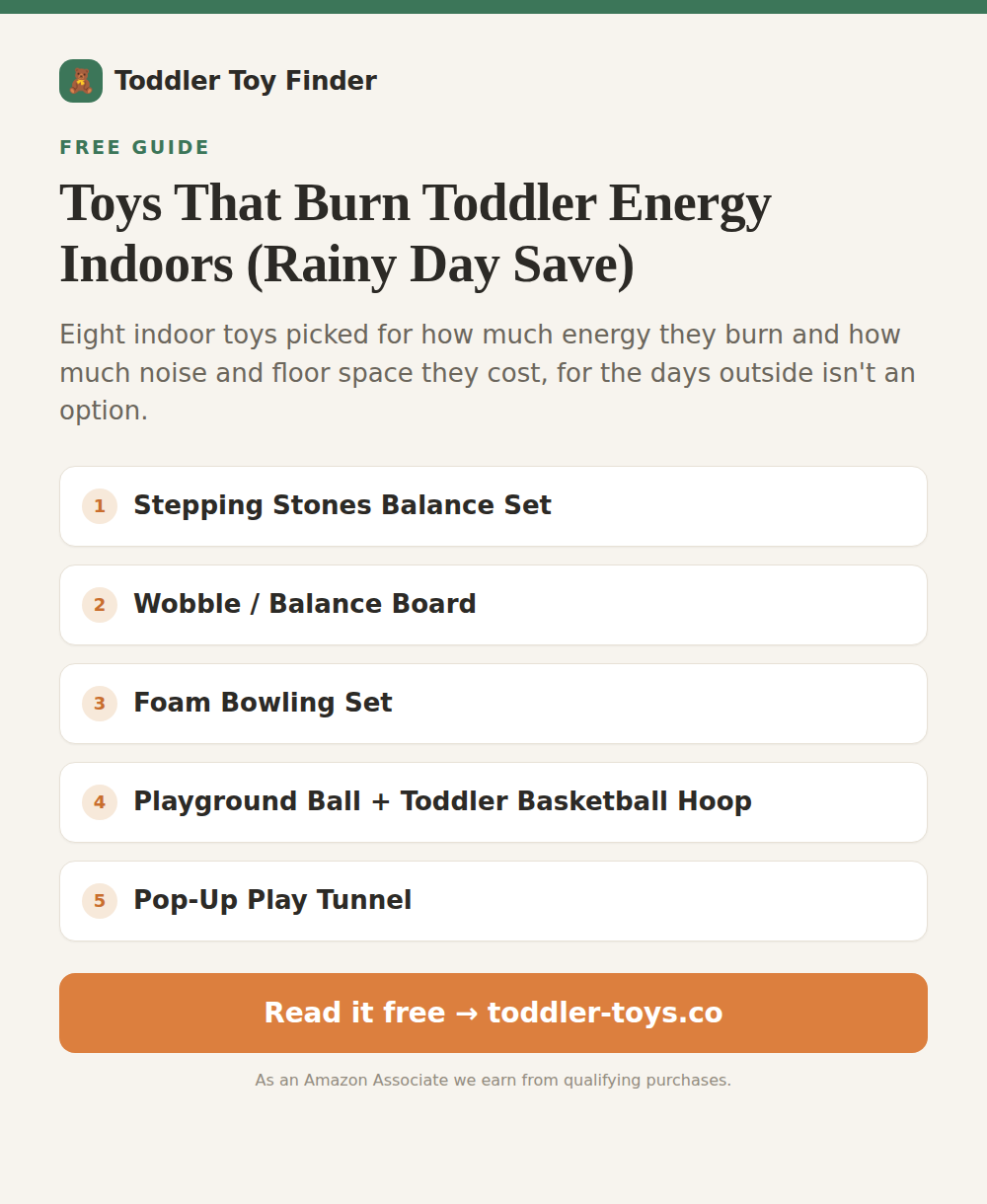
The problem with a three-year-old on a wet Tuesday isn't a lack of energy, it's a lack of somewhere to put it. Outdoors solves this for free — running, climbing, a slope to fall down. Indoors you're working against a fixed floor plan, a ceiling, and usually a neighbour, and most toy lists don't take any of that seriously. They recommend the same ride-on cars and scooters that need a driveway, then wonder why the toy sits in the hall.
This list is only toys that work inside a normal room. Each one has to do real physical work — not fiddly hands, actual legs and lungs and balance — while staying inside the limits an indoor toy actually has: floor space, noise, and how much clearing-away it demands before someone will use it again tomorrow.
Eight picks, sorted loosely from quietest to loudest, plus which floor and which neighbours each one needs.
The picks
Stepping Stones Balance Set
Lay a route across the living room and the game is already different from yesterday's, because you rearranged it, not because you bought anything new. This is the one to reach for first on a rainy day — it scales from a short wobble to a full lap of the room as they get steadier.
Watch out: On hard floors the non-slip feet matter enormously; without them this becomes a hazard rather than a challenge. Falls happen by design, so it needs a sensible surface. Stackable versions store well, which is worth paying for.
Skip it if: If you have no floor space to leave a course out, it gets set up rarely and the value collapses. This needs somewhere it can live.
How long it lasts: Two to seven years, because the courses get harder as they do.
Wobble / Balance Board
Bridge the gap between two stepping stones with this and you've turned two cheap toys into one longer course without buying a third thing. Flip it the other way and it stops being a balance test entirely and becomes a rocking boat, a ramp, a den roof — same object, different job.
Watch out: Weight and finish vary hugely between makers, and a cheap one with a rough surface or a sharp edge is genuinely worse than none. It's bulky and doesn't stack. On hard floors it slides and it's noisy.
Skip it if: If you want a toy with an obvious purpose your child will grasp immediately, this isn't that — some children need it demonstrated a few times before it clicks.
How long it lasts: Two to ten years. Very few toys here span into school age.
Foam Bowling Set
The one genuinely quiet entry on this list, which matters more than it sounds — useful for the hour before bed when you want tired legs from all the re-setting and retrieving of pins, but not a wound-up child who's just been jumping on something.
Watch out: Foam pins are light enough to fall from a draught, which frustrates a child who has just set them up carefully. On carpet the ball barely rolls — this is a hard-floor toy. The printed numbers rub off quickly on cheaper sets.
Skip it if: If you already have a skittles set or an indoor basketball hoop, the overlap is real and this adds little.
How long it lasts: Two to five years, though after four most children want a heavier ball and a proper alley.
Playground Ball + Toddler Basketball Hoop
Cheapest thing here by a wide margin and the easiest to fold into a longer session with the others: bowl the pins, cross the stones, finish with ten shots at the hoop, and twenty minutes has gone by without repeating a single movement.
Watch out: Lightweight hoops tip over when a child hangs off the rim, and they will. Some bases fill with sand or water for stability — do that. Indoors, expect things to get knocked off shelves.
Skip it if: There's very little reason to skip this. If space is tight, buy just the ball; most of the benefit is in throwing and catching.
How long it lasts: Two to eight years, easily the widest span on this list.
Pop-Up Play Tunnel
Fastest thing on this list to set up and, if you fold it away after every use, the fastest to quietly stop getting chosen. Leave it open somewhere slightly in the way — a tunnel that has to be retrieved from a cupboard loses to whatever's already out.
Watch out: The sprung frame snaps flat with real force when it collapses, so it is not something to leave a child to fold alone. The mesh panels tear if dragged across concrete. Cheaper versions have a strong plastic smell for the first week.
Skip it if: Not worth it if you have no floor space to leave it open — a tunnel that lives folded in a cupboard gets forgotten in a fortnight.
How long it lasts: Eighteen months to about five years, though the play changes from crawling through to hiding inside.
Pikler-Style Climbing Triangle
This one's for the child who's already climbing the bookcase regardless of what you buy. It doesn't create a new drive so much as give an existing one a padded, repeatable place to happen — the same rungs every time, so the ceiling on how high they push it is theirs, not yours.
Watch out: Buy on build quality, not price. Check the hinge locks positively, look for a sanded finish, and put it on a soft surface. Foldable models are worth it because an unfoldable one dominates a room permanently.
Skip it if: Skip if your child isn't a climber — plenty aren't, and for them it's a large wooden object gathering laundry. Also skip if the only place it fits is next to a hard floor.
How long it lasts: One to five years, and it holds resale value very well because demand is steady.
Bouncy Hopper Ball with Handle
Highest energy burn per square foot of anything on this list — a clear patch of about six feet by six is enough, and a three-year-old bouncing in it for ten minutes is genuinely tired, in a way a much bigger toy in a much bigger space often isn't.
Watch out: It needs a soft floor and clear space — on tile or near a coffee table it is a bad idea. Cheap ones lose air steadily and the pump they include is usually poor, so expect to top it up with a bike pump. Check the seam around the handle on older ones.
Skip it if: Skip if your ceilings are low, your floors are hard, or you live above someone. The thumping carries and there is no quiet version of this toy.
How long it lasts: Roughly ages three to six. Outgrown by weight rather than interest — they stop bouncing well once a child gets heavy enough to flatten the ball.
Indoor Toddler Trampoline with Handle
The loudest and most effective option here, and the one to buy last, once you know whether your floor and your downstairs neighbours can take it. It will move the jumping off the sofa. Whether that trade is worth it depends entirely on what's underneath your feet.
Watch out: Bungee-corded ones are quieter and gentler than steel-sprung ones; springs pinch and are loud. It must go on a flat floor with clearance overhead and nothing hard beside it. This is not an unsupervised toy, and one child at a time is a rule worth enforcing from day one.
Skip it if: Skip in a flat with neighbours below, or in any room where it would have to be dragged out and put away each time — the ones that get used are the ones left standing.
How long it lasts: Two to six years, limited by the weight rating rather than by interest.
Or use the finder to narrow these down by what you want it to help with →
Why indoors is the harder problem
Outside, a three-year-old's energy mostly solves itself — there's room to run flat out, a slope to fall down, enough noise already in the environment that theirs doesn't stand out. None of that is true indoors. A room has a fixed size, a floor that's either forgiving or isn't, and walls that carry sound to people who didn't sign up for it. An indoor toy has to do the same physical job an outdoor one does — real leg work, real balance, real exertion — inside constraints that an outdoor toy never has to think about.
That's why the same toy can be brilliant in one house and useless in another. A trampoline that's a lifeline in a ground-floor house with a garden is a genuine problem in a flat above someone else's ceiling. A climbing triangle that's essential for a child who scales the furniture is dead weight for one who doesn't climb at all. There's no universal answer here, which is exactly why most generic lists get this category wrong — they recommend the toy, not the fit.
The honest approach is to buy for your actual floor plan: how much clear space you can dedicate, how forgiving the flooring is when someone falls off something, and how much noise your walls and neighbours will tolerate at 5pm. Get that right first and almost anything on this list will earn its space.
What doesn't actually burn energy, whatever the box says
Screens are the obvious one, and worth saying plainly: a screen buys quiet, not tiredness. A wound-up three-year-old who's been sitting still for forty minutes is not a calmer three-year-old, just a delayed one — the energy that didn't go anywhere is still there when the screen goes off, usually with less patience attached.
Less obviously, a lot of "active" toys marketed at this age are actually fine-motor toys wearing an active label — a activity cube with spinners and latches keeps hands busy, which is a real and different thing from tiring out a whole body. If the goal is genuinely burning energy rather than occupying attention, the toy needs to move the child, not just their fingers.
And watch for toys that need constant adult operation to stay interesting — a ball pit that's fun for five minutes until someone has to keep refilling it, or a game with rules a three-year-old can't yet hold onto without help. The toys that actually work at this age are the ones a child can restart alone once they've had enough of it, because that's what turns fifteen minutes into forty-five.
Matching the toy to your actual room
Floor matters more than almost anything else on this list. Hard floors are unforgiving for anything involving falling — which is most of these — so a rug, a gym mat, or at minimum a clear runway free of furniture edges makes a genuine difference to what you can safely leave out. Foam bowling and stepping stones are the most forgiving of a hard floor; the hopper ball and the trampoline are the least.
Ceiling and neighbours matter for anything involving jumping or a raised platform. A trampoline in a top-floor flat is a different purchase from a trampoline in a ground-floor house with a garden underneath — same box, very different verdict, and it's worth being honest with yourself about which one you actually have before buying.
Storage decides what gets used, not what gets bought. A tunnel or a balance board that lives folded in a cupboard loses every single time to whatever's already sitting in the middle of the floor. If nothing changes about where a toy lives when it's not in use, assume it'll be used roughly as often as it currently is — which, for most half-forgotten toys, is not very.
Common questions
Will any of these actually tire out a 3-year-old before dinner?
The hopper ball and the trampoline are the two most reliable for genuine physical tiredness, not just occupied attention — both ask for continuous whole-body effort rather than short bursts. Ten to fifteen minutes of either is usually enough to take the edge off, though a determined three-year-old can outlast a lot of adult optimism.
We live in a flat with neighbours below — what's actually usable?
Skip the trampoline and the hopper ball, both of which produce a real thump through a floor, and lean on stepping stones, the balance board, foam bowling and the climbing triangle instead. None of them are silent, but they're footsteps-and-play loud rather than impact loud, which is a genuinely different thing to live above.
Is it a problem that my child only wants to jump and climb, not sit and build?
No — it's a preference, not a gap, and it tends to run in phases rather than settling permanently one way. Giving that drive somewhere appropriate to happen, rather than trying to redirect it into quieter play, usually does more good than pushing tabletop toys a child isn't currently interested in.
Do I need to supervise all of these?
The trampoline and the climbing triangle need an adult in the room, full stop — falls happen by design with both, and that's not optional at this age. The bowling set, stones, and hoop are reasonable to leave a child with alone once they know the basic rules, though a check-in every few minutes is sensible with any of them.
Should indoor toys replace time outside, if the weather's usually fine?
No — nothing on this list is meant to compete with outdoor time when it's genuinely available; it's meant to cover the days it isn't. Outside offers space and terrain no room can match, so treat this as the wet-Tuesday and short-winter-afternoon answer, not the everyday one.
More guides
- Best Toys for 6 to 12 Month Olds
- Best Toys for 1-Year-Olds
- First Birthday Gift Ideas That Get Used
- Best Toys for 18-Month-Olds
- Fine Motor Toys for Toddlers
- Best Toys for 2-Year-Olds
- Genuinely Good Toddler Gifts Under $25
- Screen-Free Calm-Down Toys for Toddlers
- Toys That Help Toddlers Talk
- Best Toys for 3-Year-Olds
- Best Toys for 4-Year-Olds