Screen-Free Calm-Down Toys for Toddlers
Updated 2026-08-13 · As an Amazon Associate we earn from qualifying purchases.
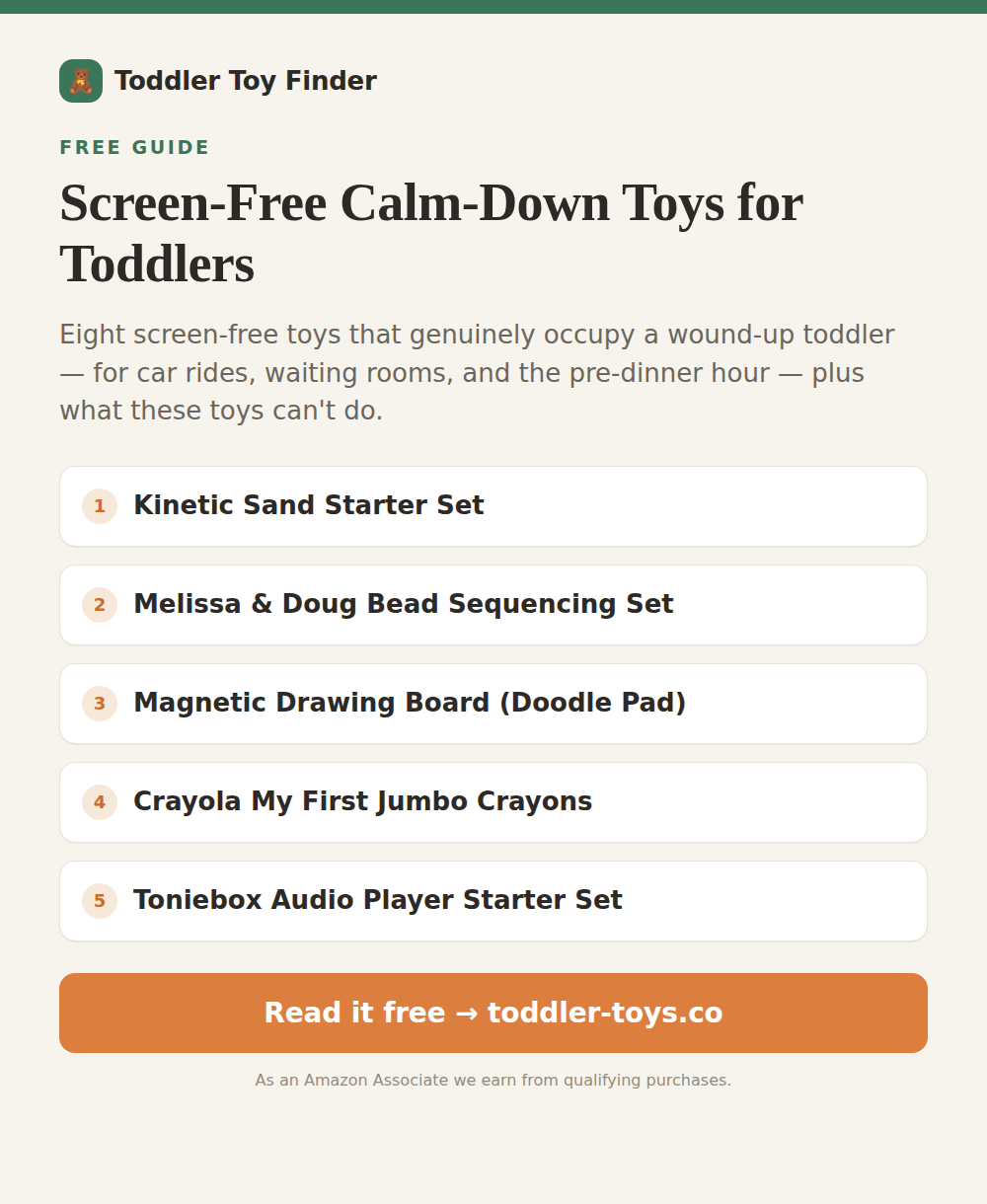
Every list like this eventually oversells itself, so start with the honest version: no toy stops a tantrum that has already arrived. Once a two-year-old is on the floor mid-meltdown, nothing you hand them is getting picked up — that moment is a nervous system running its course, not a shopping problem. What these toys are actually good for is earlier and later than that: filling the restless run-up before things tip over, and giving hands something to do during the long flat stretches of a day that otherwise end in someone climbing the bookshelf.
The toys that work for this share a few traits. They don't beep, flash, or reward a button press with a burst of noise — that pattern is stimulating, not settling, and it trains a child to expect the next hit rather than to sit with what's in front of them. They have no fixed outcome, so there's no way to lose or get it wrong, which matters because frustration is usually what tips restless into upset in the first place. And most of them are repetitive in a way that adults find boring and toddlers find steadying — pour, stack, knock down, again.
This list skips the toys already covered well elsewhere on this site — the DUPLO, the puzzles, the Play-Doh — and focuses on the ones whose whole job is buying you calm minutes at the specific hours when you need them: the car, the waiting room, the hour before dinner, the wind-down before a nap. A few of these will already be in your house doing a different job. Used at the right moment, they do this one too.
The picks
Kinetic Sand Starter Set
Of everything on this page, this is the one that most reliably absorbs a toddler who is winding up rather than winding down. There's no way to do it wrong and nothing to build toward, so a child who's already frustrated with everything else can't get frustrated with this — hands just stay busy squeezing and cutting it for fifteen or twenty minutes.
Watch out: It does escape the tray, and it clings to socks and travels through a house. Vacuum it rather than trying to wipe it. It's non-toxic but unpleasant to taste, and it grabs hair and carpet fibres permanently.
Skip it if: Skip if you'd only allow it under close supervision — like Play-Doh, a sensory material that rarely comes out isn't worth the shelf space.
How long it lasts: Three to eight years. It doesn't dry out, which is its main advantage over Play-Doh.
Melissa & Doug Bead Sequencing Set
This one needs a child who is already willing to sit, so it's not for the moment a meltdown is building — it's for the late-afternoon lull before dinner, at a table, when threading beads onto a rod by pattern is exactly tedious enough to hold their attention without asking much of you.
Watch out: Beads are large enough to be safe for the target age but small enough to vanish, and the pattern cards bend and get chewed. The wooden rods can crack if a child leans on a completed stack.
Skip it if: It needs a child who will sit down. If yours plays standing up and in motion, this will be abandoned in a week regardless of how good it is.
How long it lasts: Two to three years, because the pattern cards scale in difficulty as they grow.
Magnetic Drawing Board (Doodle Pad)
The erase lever is doing more work here than the drawing is. Wiping the screen blank and starting over is its own small satisfying reset, which is why this is the one to hand into a car seat — it can't spill, can't run out, and gives them a task with a built-in undo.
Watch out: The pen is attached by a string that snaps, and a magnetic board without its pen is finished — this is the single most common way these die. Faint ghosting builds up over time and can't be cleared. Screens crack if stood on.
Skip it if: It won't replace crayons and paper for actual creative work; lines are thin and grey and there's no colour permanence. Buy it for the car and the waiting room, not as your drawing solution.
How long it lasts: Twelve months to four years, usually ended by the pen.
Crayola My First Jumbo Crayons
Scribbling with a fist grip is a bigger, more physical movement than it looks like from across the room — full arm circles rather than fine wrist motion — which makes it a genuine outlet for restlessness rather than just something to look at, and a better one than a screen for that specific job.
Watch out: Washable is a claim with limits: they come off painted walls and most fabric, and they do not come off untreated wood or a fabric sofa. They also snap under real pressure, and a snapped crayon is briefly a tragedy.
Skip it if: If your child is already drawing recognisable shapes, move to standard crayons or pencils — the jumbo barrel starts working against fine control.
How long it lasts: Consumable. Expect to replace them, and buy the bigger box.
Toniebox Audio Player Starter Set
The only toy on this list that needs no hands from you at all: press the figure down and walk away. That makes it the right tool for the twenty minutes before bed when you need your own hands free, not for a meltdown already underway, since starting it requires a child calm enough to choose a character first.
Watch out: The real cost isn't the box, it's the figures — each one is a separate purchase and they add up fast. The box is rechargeable and reasonably tough, but the figures are small enough to lose and a lost one is expensive.
Skip it if: If you already have a decent speaker and are happy queuing audiobooks yourself, you're paying for the physical interface only. That interface is the product, so if your child doesn't need to control it, skip it.
How long it lasts: Two to seven years. One of the longest-lived things on this list.
Classic Wooden Blocks Set
Stacking asks for real concentration in a way a lot of louder toys don't, and the collapse-and-rebuild rhythm — knock it down, start again — is oddly steadying rather than frustrating for most two-year-olds. It's a better pre-nap toy than anything with a screen or a sound chip, because nothing here escalates.
Watch out: Weight cuts both ways: a falling wooden block on a bare foot or a younger sibling's head genuinely hurts. Check for sanded edges and a non-toxic finish, and be aware that cheap sets warp if they get damp, after which nothing stacks straight.
Skip it if: If your child has never shown interest in stacking anything, start with something with built-in feedback — a shape sorter or Mega Bloks — and come to blocks once building is already fun.
How long it lasts: Two to seven years. Bought once, used for a childhood, then handed on.
Bath Stacking Cups
The calming part here is mostly the bath itself — warm water and a closed, familiar room are doing the heavy lifting — but pouring water cup to cup for ten minutes with no goal and no way to fail is a genuinely good use of that time, and it's the cheapest thing on this entire page.
Watch out: The classic problem is mould inside cups with a sealed hollow; buy ones with a drainage hole or squeeze them out every time. Wet plastic in a warm bathroom grows things quickly.
Skip it if: If you already own the standard stacking cups, just take those into the bath. There's no meaningful difference beyond the drainage hole.
How long it lasts: Six months to four years, and they cost little enough to replace when the mould finally wins.
Melissa & Doug Water Wow! Reveal Pads
Keep this permanently in a bag rather than at home. Its whole value is needing zero setup and making zero mess, so it's the thing you produce the moment a restaurant wait or a waiting-room sit starts to turn — not a toy you plan around, but one you always have on hand for when you didn't plan.
Watch out: The pen is the whole product, and losing it makes the pad useless; a spare lives in some sets and is worth hunting for. The pages need a genuine dry-out before they reset, so back-to-back use in one sitting disappoints.
Skip it if: There is no real reason to skip this one. If you're only buying one thing for a flight or a restaurant, buy this.
How long it lasts: Two to four years, and it resets infinitely, which almost nothing else here does.
Or use the finder to narrow these down by what you want it to help with →
What a calm-down toy can and can't do
It can occupy hands and narrow attention onto one repetitive, low-stakes task, which is genuinely useful during the long stretches of a day where boredom or overstimulation build toward a blow-up. It can give you a specific, practiced thing to reach for in a waiting room or a car instead of a phone. What it can't do is intervene once a child is already overwhelmed — at that point they need a calmer adult and some space, not a toy, and no amount of clever design changes that timing.
The practical implication is that these work best offered early, before things tip, or afterward, once a child has already come back down and needs something quiet to occupy the last stretch of a hard hour. Reaching for one mid-meltdown usually gets it thrown, which teaches you nothing about the toy and everything about the timing.
Think of these less as tools that produce calm and more as toys that don't fight against it — nothing here flashes, escalates, or rewards a button mash with a burst of noise. That absence is the actual feature.
The moments these are actually for
Car rides are the obvious one, and the magnetic doodle pad and the Water Wow pads exist mostly for this — nothing to drop, nothing to spill, nothing that rolls under a seat. Waiting rooms are the second: any of the portable options here beats a phone at the pediatrician's, because a phone gets taken away at the door and these don't.
The hour before dinner is the one people underrate. It's the point in most days where a toddler is tired, hungry, and has been "on" since breakfast, and it's exactly when kinetic sand or a bead set at the kitchen table buys you the fifteen minutes you need to actually cook. The twenty minutes before bed is a different shape of the same problem — less about occupying hands and more about lowering the temperature of the whole room, which is where something hands-off like an audio player earns its keep.
And there's the recovery window after a hard moment has already passed — not the tantrum itself, but the ten minutes afterward when a child is spent and needs something undemanding rather than something new. Blocks or a familiar toy, not a novel one, tend to work best there.
What to skip
Anything marketed as "calming" that lights up or plays music on a button press. That pattern is stimulating by design — it's built to be pressed again — and toys built to be pressed again are the opposite of what buys you a quiet ten minutes. Read past the packaging copy and judge the toy by what it actually does when the button stops being new, which is usually within a week.
Sensory bins and kits with a dozen small loose parts sound right in theory and create a cleanup argument in practice, which undoes the calm before it starts. If a toy needs setup or produces mess that has to be managed in real time, it's adding a task for you rather than removing one.
And it's worth being honest that a screen does the occupying part of this job more reliably than anything on this list — that's exactly why it's tempting, and exactly why it's worth having a real alternative in the bag before you're standing in a restaurant deciding in the moment. Having one of these already practiced and already boring in a good way beats reaching for a phone by default.
Common questions
Will any of these actually stop a tantrum?
No, and be wary of anything that claims otherwise. Once a toddler is mid-meltdown, the moment for a toy has passed — what helps then is a calmer adult and a bit of space. These are for the run-up and the recovery, not the peak.
What's the difference between a calm-down toy and a regular fidget toy?
Mostly framing rather than mechanism. A fidget toy is judged on keeping hands busy for a minute; a calm-down toy on this list is chosen for holding attention for ten or fifteen minutes without escalating, which rules out most things with buttons, lights, or sound.
Is it a bad idea to only bring these out when things are already going wrong?
It tends to backfire. A toy only produced during a meltdown gets associated with the meltdown, and a toddler mid-upset usually rejects anything unfamiliar. These work better woven into ordinary quiet moments — the car, the wait, the wind-down — so they're already familiar by the time you need them to work.
Are these better than letting my toddler watch a video to calm down?
They ask more of a child than a screen does, which is exactly the point. A video occupies attention passively and ends the moment it's switched off; a repetitive hands-on toy holds attention through the child's own effort, and that effort is the part that tends to carry a mood past the moment the toy gets put away.
At what age do toddlers start actually using calm-down toys like these?
Most of this list works from around two, once a child can sit with one task for several minutes at a stretch. Before that, the honest answer is that very little reliably calms a toddler on demand, and the toy matters less than a predictable routine around naps and meals.
More guides
- Best Toys for 6 to 12 Month Olds
- Best Toys for 1-Year-Olds
- First Birthday Gift Ideas That Get Used
- Best Toys for 18-Month-Olds
- Fine Motor Toys for Toddlers
- Best Toys for 2-Year-Olds
- Genuinely Good Toddler Gifts Under $25
- Toys That Help Toddlers Talk
- Best Toys for 3-Year-Olds
- Toys That Burn Toddler Energy Indoors
- Best Toys for 4-Year-Olds