Best Toys for 4-Year-Olds
Updated 2026-08-09 · As an Amazon Associate we earn from qualifying purchases.
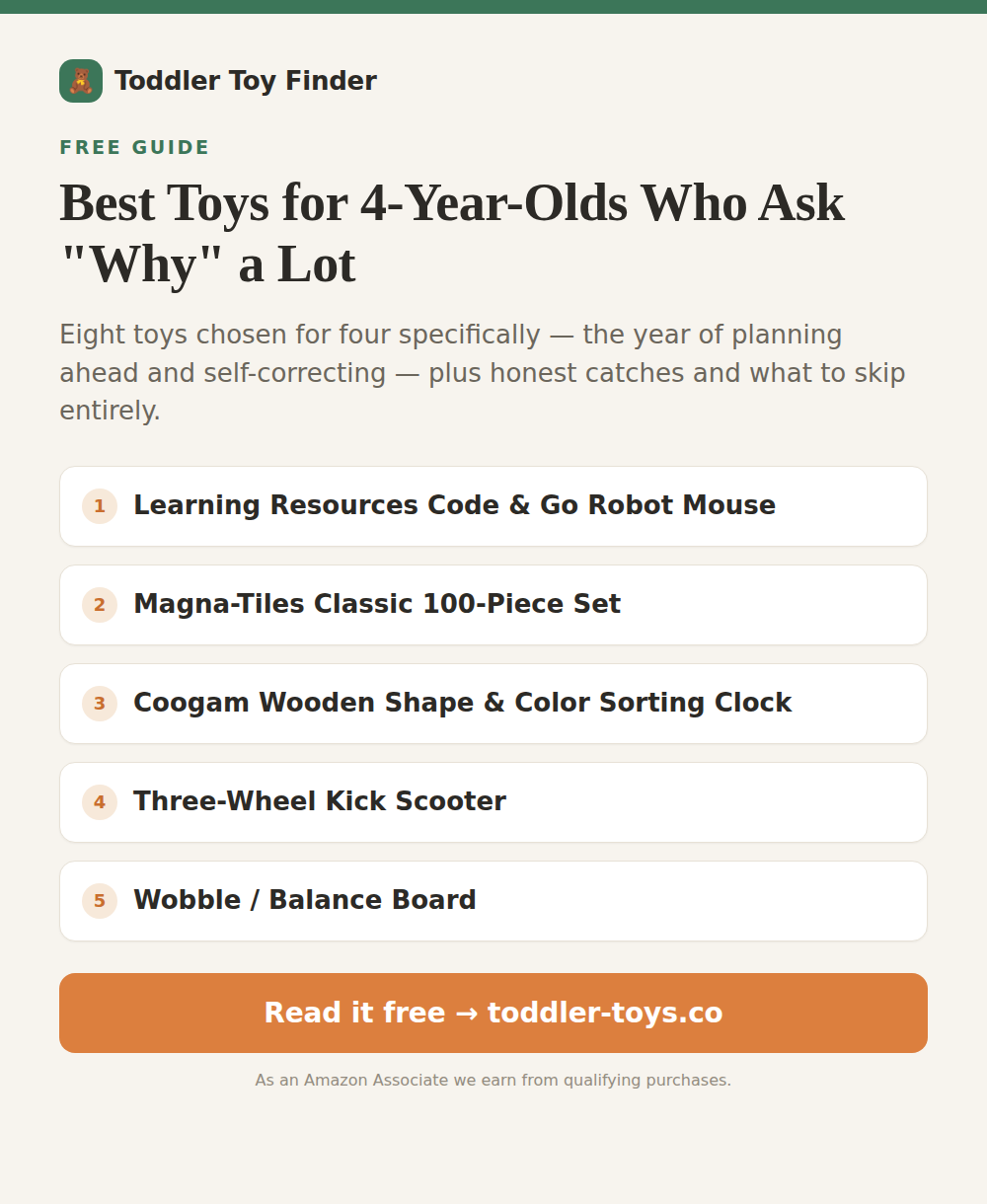
Three-year-olds discover a challenge by running straight into it. Four-year-olds stop and think first, at least sometimes, and that small pause is the real story of this age. A four-year-old can hold a short plan in mind before acting on it — line up the whole scooter route, decide where the tower needs a wider base, pick the low branch of the climbing frame on purpose rather than by accident. When the plan fails, they're increasingly able to notice where it went wrong themselves, instead of needing an adult to point it out.
That shift changes what's worth buying. A toy that gives instant, identical feedback every time — press this, hear that — stops holding attention the way it did a year ago, because there's nothing left to figure out after the second try. What replaces it are toys with a genuine wrong answer: a route that needs re-planning, a build that needs a wider base, a game with an actual opponent instead of a script. Patience for real rules is still thin and losing is still mostly unwelcome, so this isn't the year of board games yet — but it's close enough that some toys on this list are clearly rehearsing for it.
Physically, four isn't more capable than three so much as more deliberate. They choose the harder route up something on purpose, they steer rather than just barrel forward, and they're old enough now to actually get real height off a bouncing ball or real distance out of a scooter. Prices below are shown in rough bands rather than dollar figures — Amazon repricing would make an exact number here wrong within days of publishing.
The picks
Learning Resources Code & Go Robot Mouse
The clearest example on this list of a toy that didn't really work at three and does at four — planning a whole route before pressing go needs the hold-a-sequence-in-mind thinking that mostly isn't there a year earlier. The genuinely useful part is the failure: when the mouse ends up somewhere wrong, they have to work out which single card was the mistake rather than just retrying at random. Some children hit real frustration on the first few failed runs, so plan to sit nearby for those.
Watch out: There's a genuine frustration curve here and some children hit it hard; the first few failed routes need an adult nearby. It runs on batteries that die at the worst moment, and the maze walls are flimsy.
Skip it if: Below about three and a half, planning more than two steps ahead isn't there yet and this becomes a push-the-button toy — you're paying a lot for that. Skip if your child is easily frustrated by delayed feedback.
How long it lasts: Four to seven years, and it genuinely gets better as they get older.
Magna-Tiles Classic 100-Piece Set
Bought at two or three this mostly gets stacked and knocked down; bought fresh at four it gets planned — a garage with a working door, a tower rebuilt on purpose after it collapses, a shape copied from memory rather than by trial and error. It's the one genuinely expensive item worth defending here, because a four-year-old gets more out of a hundred tiles than a younger sibling does, not less. Add a second small box before that sibling wants in, or the build time gets eaten by turn-taking arguments.
Watch out: The magnets sit sealed inside a plastic shell. The risk isn't the magnet, it's a cracked tile, so retire any that split rather than taping them. Also: 100 pieces sounds enormous and stops being enough the moment a sibling joins in.
Skip it if: Under about two and a half there isn't much construction happening yet — they'll stack two tiles and wander off, and you've spent a lot for that. Cheap imitations vary wildly in magnet strength, and a weak set is genuinely worse than none, because nothing stays standing and the child concludes it doesn't work.
How long it lasts: Years. One of the few toys that gets more use at five than at three.
Coogam Wooden Shape & Color Sorting Clock
The shape sorting is close to solved by four; the actual value now is the numbers becoming familiar objects long before they mean anything mathematically, the way a stop sign is recognised as a shape before it's read as a word. It's a quiet toy, not a showpiece, and it works better left out on a shelf than wrapped for a birthday. Skip it if a shape sorter and a set of number blocks already live in the house — the clock face alone isn't reason enough to buy the idea twice.
Watch out: Cheaper versions of this design have rough edges and paint that chips; check for a smooth finish. The hands are the most fragile part and the first thing to break.
Skip it if: If you already own a shape sorter and a set of number blocks, this is mostly redundant — the clock alone isn't worth a new purchase.
How long it lasts: Two years, with the clock element only really landing in the second one.
Three-Wheel Kick Scooter
Four is roughly when a scooter stops being a novelty and starts being how they actually cover a block, because the lean-to-steer design tends to click within an afternoon rather than a season. It changes the shape of a walk — they get themselves there instead of dawdling through it or being carried. A wobbly join between column and deck ruins the whole thing fast, so the adjustable, rigid model is worth paying up for rather than the cheapest option on the shelf.
Watch out: Helmet, always. The good ones have a wide deck and a low centre of gravity; the cheap ones wobble at the joint between column and deck, which is exactly where a fall comes from. Check whether the column height adjusts before buying, because it is the difference between two years of use and four.
Skip it if: Pointless if you have no pavement, path or hard floor to use it on. It is also a poor first outdoor toy for a nervous child — a balance bike is more forgiving because both feet reach the ground.
How long it lasts: Three to about seven if the column adjusts. This is one of the few things on the list a child keeps using well past toddlerhood.
Wobble / Balance Board
Balancing on it is only half of why this earns a place; flipped over it becomes a bridge, a boat, a ramp for toy cars, a rocking chair mid pretend-story, and a four-year-old will find a use for it that was never in any instructions. That open-endedness is what keeps it in rotation after the balancing itself stops being a novelty. It needs demonstrating a couple of times before the point of it lands — don't hand it over expecting them to invent the game unprompted.
Watch out: Weight and finish vary hugely between makers, and a cheap one with a rough surface or a sharp edge is genuinely worse than none. It's bulky and doesn't stack. On hard floors it slides and it's noisy.
Skip it if: If you want a toy with an obvious purpose your child will grasp immediately, this isn't that — some children need it demonstrated a few times before it clicks.
How long it lasts: Two to ten years. Very few toys here span into school age.
Bouncy Hopper Ball with Handle
The cheapest thing on this list, and in a house with no yard probably the most-reached-for — a real outlet for the energy that would otherwise land on the furniture. Four-year-olds are heavy enough now to get genuine height off it, which is more satisfying than it was a year earlier and considerably louder too, so think about what's underneath the room before buying. Not the toy to give anyone who lives above a neighbour they'd like to keep.
Watch out: It needs a soft floor and clear space — on tile or near a coffee table it is a bad idea. Cheap ones lose air steadily and the pump they include is usually poor, so expect to top it up with a bike pump. Check the seam around the handle on older ones.
Skip it if: Skip if your ceilings are low, your floors are hard, or you live above someone. The thumping carries and there is no quiet version of this toy.
How long it lasts: Roughly ages three to six. Outgrown by weight rather than interest — they stop bouncing well once a child gets heavy enough to flatten the ball.
Melissa & Doug Examine & Treat Vet / Doctor Set
What changes at four is that this stops being solitary narration and turns into an actual two-person scene with a plot and real negotiation over who's the patient this time — a noticeably more demanding kind of back-and-forth than naming the pieces alone ever was. It only works with a willing second player, and a grown-up happy to sit still and be examined more than once is doing most of the real work here, not the toy itself.
Watch out: The stethoscope and blood-pressure cuff are the pieces that break, and the fabric bag wears at the seams. Nothing here does anything on its own, so it needs a play partner to get going, at least at first.
Skip it if: If your child plays mostly alone, this sits unused — it's a two-person toy in practice, whatever the box says.
How long it lasts: Two to four years, peaking around three when pretend play really takes hold.
Toniebox Audio Player Starter Set
By four the appeal isn't just pressing play, it's the actual browsing — swapping a figure mid-story because they've decided they'd rather hear something else, which is a small but genuine exercise in changing their own mind on purpose. It buys a reliably quiet twenty minutes without the fight over switching off a screen afterward. The figures, not the box, are the real ongoing cost, and they vanish under sofas with impressive speed.
Watch out: The real cost isn't the box, it's the figures — each one is a separate purchase and they add up fast. The box is rechargeable and reasonably tough, but the figures are small enough to lose and a lost one is expensive.
Skip it if: If you already have a decent speaker and are happy queuing audiobooks yourself, you're paying for the physical interface only. That interface is the product, so if your child doesn't need to control it, skip it.
How long it lasts: Two to seven years. One of the longest-lived things on this list.
Or use the finder to narrow these down by what you want it to help with →
What actually changes at four
The clearest shift is planning ahead of acting. A three-year-old mostly discovers whether something will work by trying it; a four-year-old increasingly works out a plan first and only then tests it, which is why toys that reward a route, a sequence or a build suddenly land in a way they couldn't a year earlier. The flip side is self-correction — shown a failed attempt, a four-year-old is more able to find the specific step that went wrong, rather than needing it pointed out.
Attention has genuinely lengthened too, though unevenly. An absorbing toy can hold a four-year-old for twenty or thirty minutes in a way that would have been unusual at three, but that patience is task-specific and doesn't transfer automatically to sitting still through something boring, like a long car journey or a sibling's turn.
Socially, cooperative pretend play keeps deepening — two four-year-olds playing doctor or shop will assign roles, argue about fairness and sometimes actually resolve it themselves, without an adult mediating every step. Real rule-based games are close but not quite there; interest in rules is rising well before the patience to lose by them is.
What quietly fails at four
Anything with one fixed response per action. A toy that lights up or plays a tune identically every time it's pressed had a real run at two and three, but a four-year-old notices the sameness fast and moves on, because there's nothing left to plan around or get wrong.
Toys still labelled generically for 'toddlers' are worth a second look before buying, because four is genuinely past that stretch. A shape sorter that was exactly right eighteen months ago is usually mastered and shelved by now, and buying more of the same category wastes money a more advanced version of the same idea would use better.
Real board games with scoring and elimination are still mostly early, whatever the box claims — the rules make sense to a four-year-old well before losing gracefully does, and a game that reliably ends in tears teaches them the game is unpleasant rather than fun. Save those for closer to five or six, or pick ones with no real losing condition at all.
Spending well at this age
Four is where a handful of genuinely expensive items earn their keep, because the play has gotten complex enough to actually use everything in the box. Magnetic tiles, a robot with real logic in it, and a screen-free audio player all belong in that category — things that reward more sophisticated play at four than they did a year or two earlier, rather than less.
That doesn't make the cheap end pointless. A hopper ball and a wooden sorting clock together cost a fraction of one big item and get reached for just as often, sometimes more, precisely because there's nothing precious about them to protect.
The band still worth real suspicion is the mid-priced single-purpose electronic — the kind that narrates its own instructions, gets fully explored inside a week, and then goes quiet on a shelf permanently. At four specifically that trap often wears a licensed character's face, which adds cost without adding anything the child actually plays with for longer.
Common questions
Is my 4-year-old ready for board games with real rules?
Mostly not yet, though it's close. Understanding a rule and accepting a loss by it are two different skills, and the second one usually lags well behind the first through this year. Cooperative games with no real losing side, or simple games decided by chance rather than skill, tend to go better than anything competitive.
My 4-year-old still won't take turns or share fairly — is that normal?
Yes, and it's common well past this age. Genuine turn-taking is a slow skill to build, and a lot of what looks like sharing at four is still two children playing alongside each other with occasional swaps rather than real negotiation. Toys with built-in roles — a shared pretend scenario, a game with an obvious next player — tend to move this along faster than being told to share does.
Is a screen-free audio player actually worth it over just handing over a tablet?
It buys something a tablet doesn't: the child fully controls the experience without needing a screen to look at, and there's no negotiation over turning it off afterward the way there usually is with video. It isn't a replacement for every use of a tablet, but for winding down or quiet independent time it tends to cause noticeably less friction.
What's a good gift for a 4-year-old who says they already have everything?
Look for something that gets reused in different ways rather than something that does one specific thing once. A balance board, a big box of building tiles or an audio player with a couple of new figures all keep giving a four-year-old something to do with them months later, in a way a single-purpose novelty usually doesn't.
More guides
- Best Toys for 6 to 12 Month Olds
- Best Toys for 1-Year-Olds
- First Birthday Gift Ideas That Get Used
- Best Toys for 18-Month-Olds
- Fine Motor Toys for Toddlers
- Best Toys for 2-Year-Olds
- Genuinely Good Toddler Gifts Under $25
- Screen-Free Calm-Down Toys for Toddlers
- Toys That Help Toddlers Talk
- Best Toys for 3-Year-Olds
- Toys That Burn Toddler Energy Indoors