Best Toys for 1-Year-Olds
Updated 2026-08-05 · As an Amazon Associate we earn from qualifying purchases.
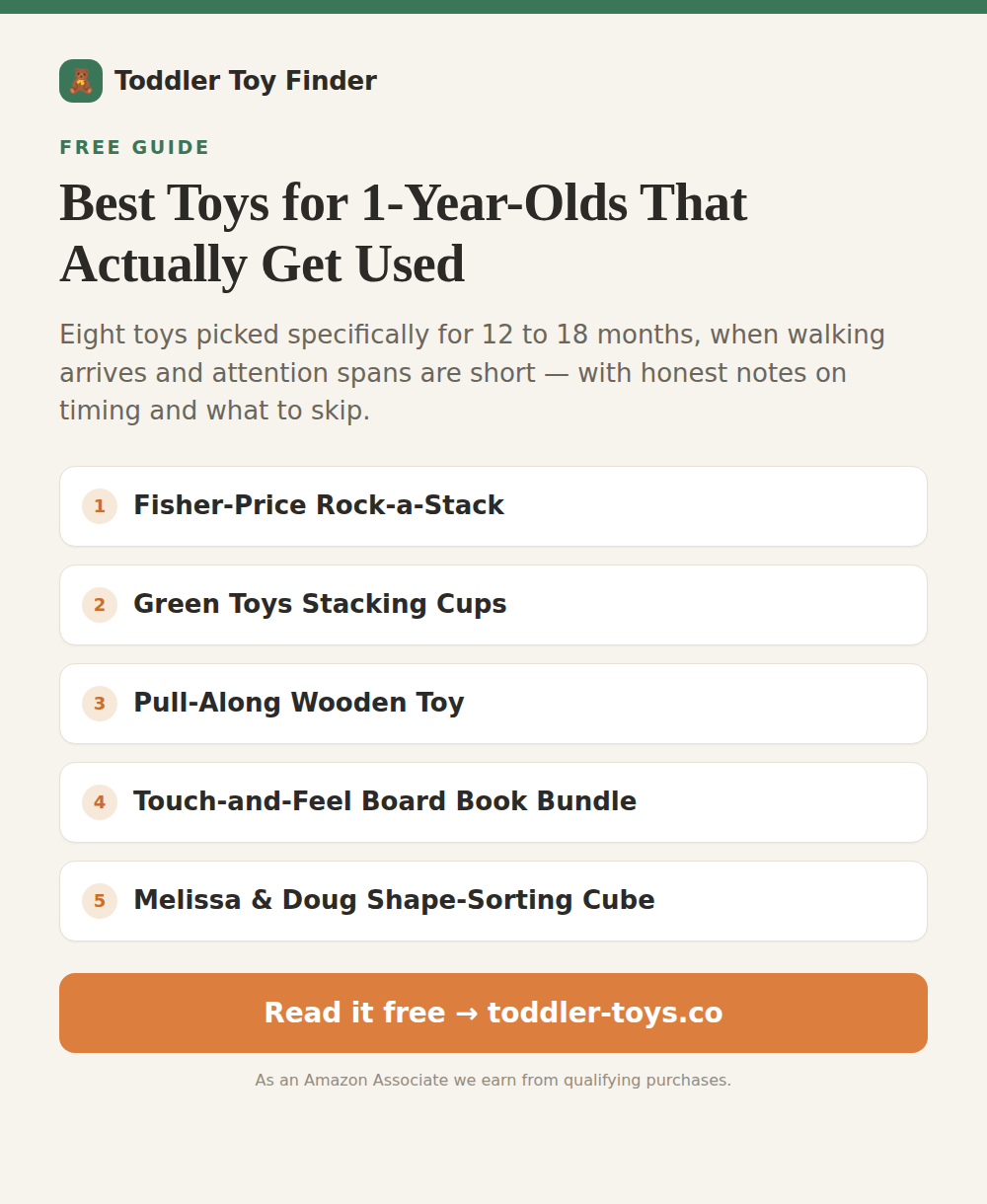
The twelve-to-eighteen-month stretch is the most chaotic window in toy buying. A child who was flat on a mat at their last birthday is now upright, cruising the couch, and testing what happens when a cup goes off the table for the ninth time in a row. Most "best toys" lists blur ages ten through twenty-four together and hand you the same generic pile regardless of where a child actually is. This one is narrower: eight toys picked for the walking-and-babbling stage specifically, not a list that happens to also work for a four-year-old.
What's happening developmentally in this window is a fast handoff between skills. Gross motor comes first — pulling to stand, then a few unsteady steps — and it tends to dominate for a couple of months before fine motor and early words catch up and start competing for attention. A toy built only for lying on a mat gets abandoned fast once a child is upright; a toy demanding real two-handed coordination often arrives a few months too early. The picks below lean toward things that meet a child roughly where they are for a season, rather than toys that are aspirational for a skill that hasn't shown up yet.
Prices below are grouped into bands, not sticker numbers — Amazon reprices constantly, and any dollar figure printed here would be stale within days.
The picks
Fisher-Price Rock-a-Stack
At twelve months this is usually still a mouthing toy; somewhere around sixteen or seventeen months you'll watch the aiming suddenly click into place. Buy it now rather than waiting — it earns its keep across that whole gap, not just the back half of it.
Watch out: The rings are soft plastic and the smallest is genuinely small, so this is a supervised toy while everything still goes in the mouth. Colours dull if you run it through a dishwasher; wash it by hand and it stays bright for years.
Skip it if: If you already own a set of stacking cups, skip this. Cups cover most of the same ground, cost less, and stay interesting roughly twice as long.
How long it lasts: About six to eighteen months of real interest, then it becomes bath-toy background.
Green Toys Stacking Cups
A cup carried from room to room is doing more good than a shelf of louder toys. At this age the appeal isn't nesting technique yet — it's mouthing the rim and banging two together — and that's a perfectly good place for it to start.
Watch out: They are lightweight, so a tall tower topples from a breath of wind or an enthusiastic sibling. Most sets have a small hole in the base for drainage; if yours doesn't, water gets trapped in bath use and eventually goes mouldy inside.
Skip it if: There's almost no one who shouldn't own a set. If you're buying a second stacking toy after a ring stacker, buy these instead of another ring stacker.
How long it lasts: Six months to four years. Very few toys span that.
Pull-Along Wooden Toy
The window for this one is narrow, and it's exactly this age band. A child still cruising along the sofa has no use for it, but a child taking ten free steps will drag it in circles for twenty minutes. Time the purchase to the walking, not the birthday.
Watch out: The string is the concern. Keep it short, and don't leave it accessible in a cot or unsupervised — a long cord around a small child is a real hazard rather than a theoretical one. Wooden wheels mark soft flooring and are noisy on tile.
Skip it if: Pointless before they're walking steadily; bought too early it just gets dragged around on all fours and loses its novelty before it can do its job.
How long it lasts: Twelve months to two and a half years, concentrated in the first six months of walking.
Touch-and-Feel Board Book Bundle
Keep one in the diaper bag and the car seat pocket, not just the shelf. A one-year-old's attention span for anything is measured in minutes, and a textured page reliably buys more of them than almost anything else on this list.
Watch out: They get chewed, and a chewed board book delaminates. The textured patches wear bald in the popular spots. Buy accepting they're consumable rather than heirlooms.
Skip it if: Genuinely none. If the budget only stretches to one thing on this list, buy books.
How long it lasts: Birth to three, then they become the books a younger sibling destroys.
Melissa & Doug Shape-Sorting Cube
Expect frustration before mastery. At the younger end of this range, most kids solve it by finding the one obviously round hole rather than truly matching shapes — that's not failure, it's the process actually working, just slower than the box photo suggests.
Watch out: The individual blocks scatter and go missing, and a shape sorter with three shapes gone is a frustrating toy rather than a fun one. Keep them in one bag. The lid is removable, which is a mercy when something gets stuck inside.
Skip it if: Under about fourteen months, the failure rate is high enough to be discouraging rather than interesting. Wait until they're posting things into gaps on their own before buying.
How long it lasts: Roughly a year of intense use. Retains resale value well because it's nearly indestructible.
Montessori Object Permanence Box
Say almost nothing while they play with this one. The appeal is entirely self-directed — the ball vanishes, then reappears — and an adult narrating what's happening tends to shorten the fascination rather than stretch it out.
Watch out: It is genuinely a one-trick toy, and the trick stops being magic once they've worked it out. The ball is a choking-sized sphere, so it needs supervision and it needs finding when it rolls under the sofa.
Skip it if: If you want a toy that grows with your child, this is the wrong shape of purchase — it's intense and brief by design. Skip it if you're only buying a handful of things.
How long it lasts: About four months of real fascination. Short, but it hits at an age with few good options.
Hape Pound & Tap Bench with Xylophone
Bring this out before naps, not after. It's the loudest thing on this list by a wide margin, and handing a mallet to a one-year-old right when you need them calm is a problem you're creating yourself.
Watch out: It is loud, and there is no volume control. The mallet is a stick, and a toddler with a stick will find other things to hit; some parents hide it between sessions. The xylophone slides out and gets separated from the bench almost immediately.
Skip it if: If you live in a flat with neighbours below, or anyone in the house works from home, be honest with yourself about this one.
How long it lasts: Twelve to eighteen months as a pounding toy, longer if the xylophone survives on its own.
Melissa & Doug Sound Puzzle (Farm or Vehicles)
The sound is the entire hook at this age. Most twelve-month-olds have zero interest in matching the shape correctly — they're pressing pieces purely to trigger the noise — and that repetition is still doing real word-learning work in the background.
Watch out: Battery-powered, so the sounds eventually distort or die, and at that point it's an ordinary puzzle. The pieces trigger the sound whenever they're pressed, including at 6am. There's usually an off switch — find it early.
Skip it if: If you already own a chunky puzzle and a farm animal toy, the overlap is large enough to skip this.
How long it lasts: Twelve to twenty-four months, and it stays useful as a plain puzzle once the electronics give up.
Or use the finder to narrow these down by what you want it to help with →
What actually changes between 12 and 18 months
Gross motor leads. Pulling to stand, cruising along furniture, then a handful of free steps that turn into a genuine walk over a few months — this is the headline change, and it tends to eclipse everything else for a while. A toy that only works flat on the floor loses ground fast once a child would rather be upright and moving toward something.
Fine motor is catching up close behind. The pincer grip — thumb and forefinger picking up something small — usually arrives somewhere in this window, and once it does, feeding themselves, pointing at things by name, and turning thick book pages all become possible almost at once. Toys that reward a full-fist grab start feeling too easy right around the time toys needing real finger control start feeling almost right.
Language is the quiet one. Understanding runs well ahead of speaking at this age — a child who says two or three words reliably may follow ten times that many spoken instructions. Toys that name things out loud, or that reward pointing and looking, are doing more than they appear to.
What to skip at this age
Anything with a single scripted response and nothing else. A toy that lights up and plays the same eight-second tune every time is gripping for about a week, purely on novelty, and then it's furniture. The ones that last are the ones a child can do something different to.
Seated, wheeled walkers are worth thinking twice about — the kind with a tray and wheels that let a child scoot around before their legs are doing the work. Several child-safety organizations advise against them because they can move faster than an unsteady child can control, on top of just not helping the walking itself. A stationary activity table or a push-along toy does the useful part without that risk.
Anything with more than a handful of small, separable pieces. A shape sorter with three shapes is fine; a play set with forty tiny accessories is a floor hazard for a child who still mouths things, and most children still do at this age. Save the sets with real small parts for a year or two later.
How much to actually spend at this age
Very little, most of the time. Six of the eight toys here sit in the cheapest price band, and the two that get reached for daily in most houses — the stacking cups and the board books — cost less than a takeaway meal between them.
The case for spending more is narrow, and it's mostly about how many months a toy realistically covers rather than how sophisticated it looks in a photo. A toy that's interesting for four months at this price point can be a fine buy; a toy that's interesting for four months at three times the price rarely is, unless it's also something you'd want around for a second child.
One reasonable approach for a first birthday: one slightly bigger item that clearly leads to something they'll use for years, a couple of cheap, specific things picked for exactly this age, and nothing in the crowded middle price band that neither delights on opening nor earns its shelf space six months on.
Common questions
Is 12 months too early for a shape sorter?
Not too early to own one, but expect a real gap before they solve it as intended. Most children spend the first few months treating a shape sorter as a box to put things in and take out again, without matching shapes correctly. That's normal use, not a wasted purchase — the matching skill tends to arrive closer to 15 to 18 months.
My one-year-old still puts everything in their mouth — what's actually safe to buy?
Look for the choking-hazard size guidance on the packaging rather than the marketed age range, since the two don't always agree. As a rough physical check, anything that can pass through a toilet-paper tube is a genuine risk. Board books, large soft blocks, oversized rings and stacking cups are all safe choices at this stage; sets with lots of loose small pieces are the ones to hold off on.
How many toys should a one-year-old have out at once?
Fewer than most living rooms have on display. A one-year-old engages more with three or four visible, reachable toys than with a full bin they'd have to dig through, and a smaller rotating set is also easier for them to actually finish exploring before moving on.
Should I buy a baby walker with wheels for a 12-month-old?
Worth avoiding the seated, wheeled kind specifically — it lets a child move faster than their balance and reflexes can manage, and it doesn't actually teach the walking motion. A push-along toy or a stationary activity table gives the same standing, cruising practice without letting them outrun their own coordination.
More guides
- Best Toys for 6 to 12 Month Olds
- First Birthday Gift Ideas That Get Used
- Best Toys for 18-Month-Olds
- Fine Motor Toys for Toddlers
- Best Toys for 2-Year-Olds
- Genuinely Good Toddler Gifts Under $25
- Screen-Free Calm-Down Toys for Toddlers
- Toys That Help Toddlers Talk
- Best Toys for 3-Year-Olds
- Toys That Burn Toddler Energy Indoors
- Best Toys for 4-Year-Olds