Fine Motor Toys for Toddlers
Updated 2026-08-14 · As an Amazon Associate we earn from qualifying purchases.
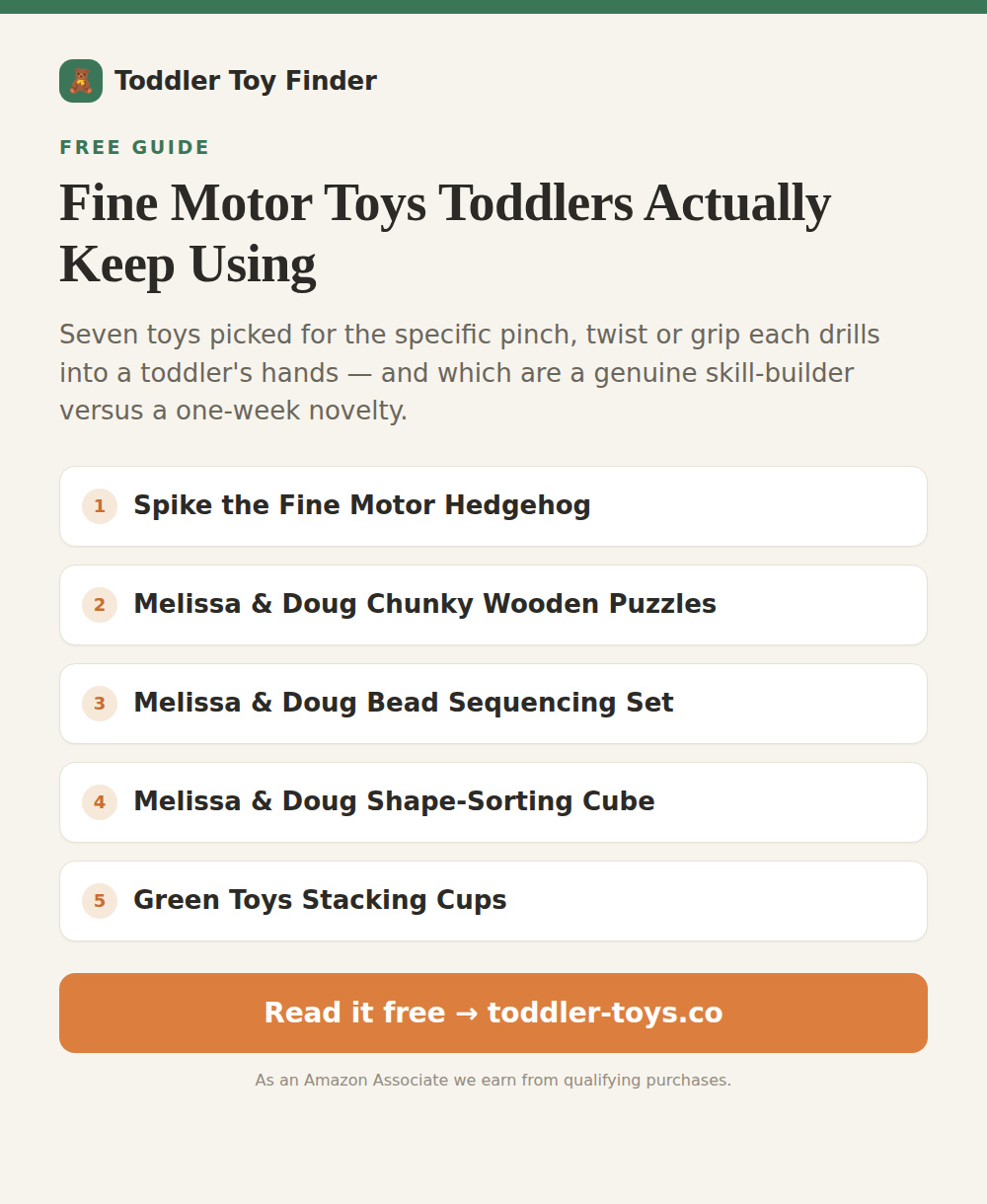
'Fine motor' gets stuck on the box of almost anything small enough to hold, which makes the label nearly useless when you're actually choosing. A toy that genuinely works the small muscles in a hand asks for something specific and slightly hard — a pinch, a twist, a controlled release — and then lets the child fail at it safely enough times to get better. A toy that just happens to be small doesn't do that; it's just small.
This list is narrower than our general age guides on purpose. Every toy here earns its place because of one particular hand movement it drills, not because it's broadly nice to have. A couple of these look almost identical to toys on our wider toddler lists, but they're here for a different reason — the grip they demand, not the play pattern around them.
Eighteen to twenty-four months is a reasonable window to lean into this deliberately. The pincer grip — thumb and forefinger working as a pair rather than a whole-fist grab — is usually well established by now, and what's still developing is control: aiming that pinch, applying the right amount of force, coordinating one hand against the other. That's what these toys are actually for. None of it is about being ahead of a curve; it's about giving hands that are ready for harder work something harder to do than a fist ever could.
The picks
Spike the Fine Motor Hedgehog
The most single-minded toy on this list, in a good way. There's no scoring, no sorting, no story — just the resistance of pulling a quill free and the aim needed to post it back into its own hole, over and over. That narrowness is the point: it isolates the exact pinch-and-place motion other toys bury inside a bigger game.
Watch out: The quills are exactly the size and shape that fits in a nostril or a mouth, so this is a supervised toy well past the age you'd expect. They also store inside the body, which is great until the plug pops out in a bag.
Skip it if: If you have a determined mouther, hold off. The play pattern needs them to be past putting everything straight in.
How long it lasts: Eighteen months to three and a half years, and it travels well — one of the better restaurant toys here.
Melissa & Doug Chunky Wooden Puzzles
The knob is doing more work than it looks like. Gripping a peg between thumb and forefinger and lifting straight up is a cleaner rehearsal for a pencil grip than most things sold explicitly as pre-writing toys, and the flat board means there's no ambiguity about whether a piece is actually seated.
Watch out: The knobs come loose eventually on heavily used sets; a dab of wood glue fixes it permanently. Printed boards can peel if they get repeatedly soaked, so this isn't a bath or outdoor toy.
Skip it if: If your child is already doing 12-piece jigsaw puzzles, this will bore them within a day. It's a stepping stone, not a destination — buy it for the year they're learning, not the year after.
How long it lasts: A busy twelve to eighteen months, then it becomes something a younger sibling inherits.
Melissa & Doug Bead Sequencing Set
Threading a bead onto a rigid rod asks two hands to do two different jobs at once — one holding steady, one aiming and pushing — which is a harder coordination task than it looks like from the box. Early attempts miss the hole entirely; that's the useful failure, not a sign the toy is pitched wrong.
Watch out: Beads are large enough to be safe for the target age but small enough to vanish, and the pattern cards bend and get chewed. The wooden rods can crack if a child leans on a completed stack.
Skip it if: It needs a child who will sit down. If yours plays standing up and in motion, this will be abandoned in a week regardless of how good it is.
How long it lasts: Two to three years, because the pattern cards scale in difficulty as they grow.
Melissa & Doug Shape-Sorting Cube
Rotating a shape in the air until it lines up with its hole, rather than just posting something into an open slot, is a distinct and harder skill than most sorting toys ask for. Watch for the shift from brute-forcing every side to visibly checking the shape before trying — that's the actual milestone, not the sorting itself.
Watch out: The individual blocks scatter and go missing, and a shape sorter with three shapes gone is a frustrating toy rather than a fun one. Keep them in one bag. The lid is removable, which is a mercy when something gets stuck inside.
Skip it if: Under about fourteen months, the failure rate is high enough to be discouraging rather than interesting. Wait until they're posting things into gaps on their own before buying.
How long it lasts: Roughly a year of intense use. Retains resale value well because it's nearly indestructible.
Green Toys Stacking Cups
Included here specifically for the smallest cup in the set, not the tower. Nesting the last one or two sizes correctly needs a precise, controlled release that the bigger cups don't demand — drop too early or too late and it bounces off the stack, which is instant, visible feedback with no adult needed to explain it.
Watch out: They are lightweight, so a tall tower topples from a breath of wind or an enthusiastic sibling. Most sets have a small hole in the base for drainage; if yours doesn't, water gets trapped in bath use and eventually goes mouldy inside.
Skip it if: There's almost no one who shouldn't own a set. If you're buying a second stacking toy after a ring stacker, buy these instead of another ring stacker.
How long it lasts: Six months to four years. Very few toys span that.
Magnetic Drawing Board (Doodle Pad)
The stylus is held in a fist at first and a proper tripod grip much later, and this is one of the few toys that tolerates the whole span of that transition without becoming boring at either end. The erase lever adds its own small grip challenge — enough resistance to notice, not enough to need an adult's hand.
Watch out: The pen is attached by a string that snaps, and a magnetic board without its pen is finished — this is the single most common way these die. Faint ghosting builds up over time and can't be cleared. Screens crack if stood on.
Skip it if: It won't replace crayons and paper for actual creative work; lines are thin and grey and there's no colour permanence. Buy it for the car and the waiting room, not as your drawing solution.
How long it lasts: Twelve months to four years, usually ended by the pen.
LEGO DUPLO Classic Brick Box
Pressing two bricks together with enough force to lock needs a two-handed push that's genuinely effortful for a small hand early on, and pulling them back apart is arguably the harder skill of the two. That combination — push to build, pull to take apart — gives more grip repetitions per minute than almost anything else on this list.
Watch out: The classic box is bricks and not much else, which is either the point or a disappointment depending on the child; some want a theme and a story. Bricks migrate into every corner of a house permanently, and stepping on one hurts less than standard LEGO but not by as much as you'd hope.
Skip it if: If you already have Mega Bloks and your child is under about two and a half, wait. Buying both at once means the DUPLO sits unused while it's still too fiddly.
How long it lasts: Three to six years easily, and it holds resale value better than nearly anything else here.
Or use the finder to narrow these down by what you want it to help with →
What 'fine motor' means once you get specific
The phrase covers a handful of genuinely different hand skills that toy marketing tends to flatten into one label. A pincer grip — thumb and forefinger meeting to pick up something small — is usually the first to arrive and the most talked about, but it's only one piece. Wrist rotation, the two-handed coordination of one hand steadying while the other works, and controlled release — letting go of something at the right moment rather than just dropping it — are separate skills that develop on their own timelines, and a toy built around one doesn't automatically train the others.
This matters when a toy underdelivers despite looking right on paper. A shape sorter that a toddler can solve by brute force, jamming pieces until one fits, is barely touching fine motor at all; the same toy becomes a real workout only once the child starts checking a shape's orientation before attempting it, which asks for a different kind of control entirely. The toy hasn't changed — the skill being practiced against it has.
The honest version of 'fine motor toy' is one that keeps demanding a slightly harder version of the same movement as the child improves, rather than being solved once and then just repeated. Threading beads and stacking the smallest cup both do this reasonably well; a toy with one big satisfying button to press generally does not, however chunky and hand-friendly it looks.
The gap between a fine-motor toy and a busy toy
Plenty of toys marketed on grip and dexterity are actually busy toys wearing fine-motor language — objects that hold attention through novelty or noise rather than through a repeatable, improvable physical challenge. A busy toy is worth owning too, but it's solving a different problem, and it's worth knowing which one you're buying.
A rough test: does the toy get easier or does the child get better at it? A busy board with a dozen latches gets exhausted once every mechanism has been solved once, and there's nowhere further to go — that's a busy toy. A bead-threading set stays hard in a slightly different way for months, because the challenge scales with grip precision rather than novelty. Neither is a bad purchase; only one of them is doing what 'fine motor' implies.
The other tell is whether a toy can be beaten by force. Anything that yields to a hard enough shove or a lucky drop isn't really asking for control, just persistence. The toys on this list were chosen partly because force alone doesn't work on any of them — a hedgehog quill jammed in sideways doesn't go back in, and a bead pushed at the wrong angle just stops.
Common questions
My toddler still grabs everything with a fist. Is that a problem at this age?
Not on its own — the shift from a whole-hand grab to a precise pincer grip happens gradually and at a real range of paces between individual children. What tends to move it along faster than any single toy is simply offering small objects to pick up regularly, in low-pressure moments, rather than only during a specific 'fine motor' activity. If a fisted grab is still the only strategy well past two, it's a reasonable thing to mention at a routine check-up rather than something to judge from a toy list.
Are fine motor toys and pre-writing toys the same thing?
Overlapping but not identical. Pre-writing specifically points toward the tripod grip used to hold a pencil, which a magnetic drawing pad or a chunky crayon works on directly. Fine motor is the broader category underneath that — pinching, twisting, threading, releasing — and most of the skill actually transfers into writing readiness even from toys that have nothing to do with drawing, like a bead-threading set or a shape sorter.
How much should I intervene when a fine motor toy is frustrating my toddler?
Less than the instinct suggests. A certain amount of visible struggle — missing the hole, dropping the piece, trying the wrong side twice — is where the actual skill-building happens, and stepping in to finish the task for them removes exactly the repetition that was doing the work. The useful move is usually narrating what's happening rather than taking over: naming the shape, the direction, the near miss, and letting the hands keep working.
Do wooden fine motor toys work better than plastic ones?
The material itself doesn't drive the skill-building — the weight and resistance do, and wood tends to have more of both by default. A heavier peg or bead gives clearer feedback when it's placed correctly versus wobbling loose, which is part of why wooden puzzles and bead sets show up so often on lists like this one. A well-designed plastic toy with the right resistance works just as well; a flimsy one of either material generally doesn't.
More guides
- Best Toys for 6 to 12 Month Olds
- Best Toys for 1-Year-Olds
- First Birthday Gift Ideas That Get Used
- Best Toys for 18-Month-Olds
- Best Toys for 2-Year-Olds
- Genuinely Good Toddler Gifts Under $25
- Screen-Free Calm-Down Toys for Toddlers
- Toys That Help Toddlers Talk
- Best Toys for 3-Year-Olds
- Toys That Burn Toddler Energy Indoors
- Best Toys for 4-Year-Olds