Best Toys for 6 to 12 Month Olds
Updated 2026-08-10 · As an Amazon Associate we earn from qualifying purchases.
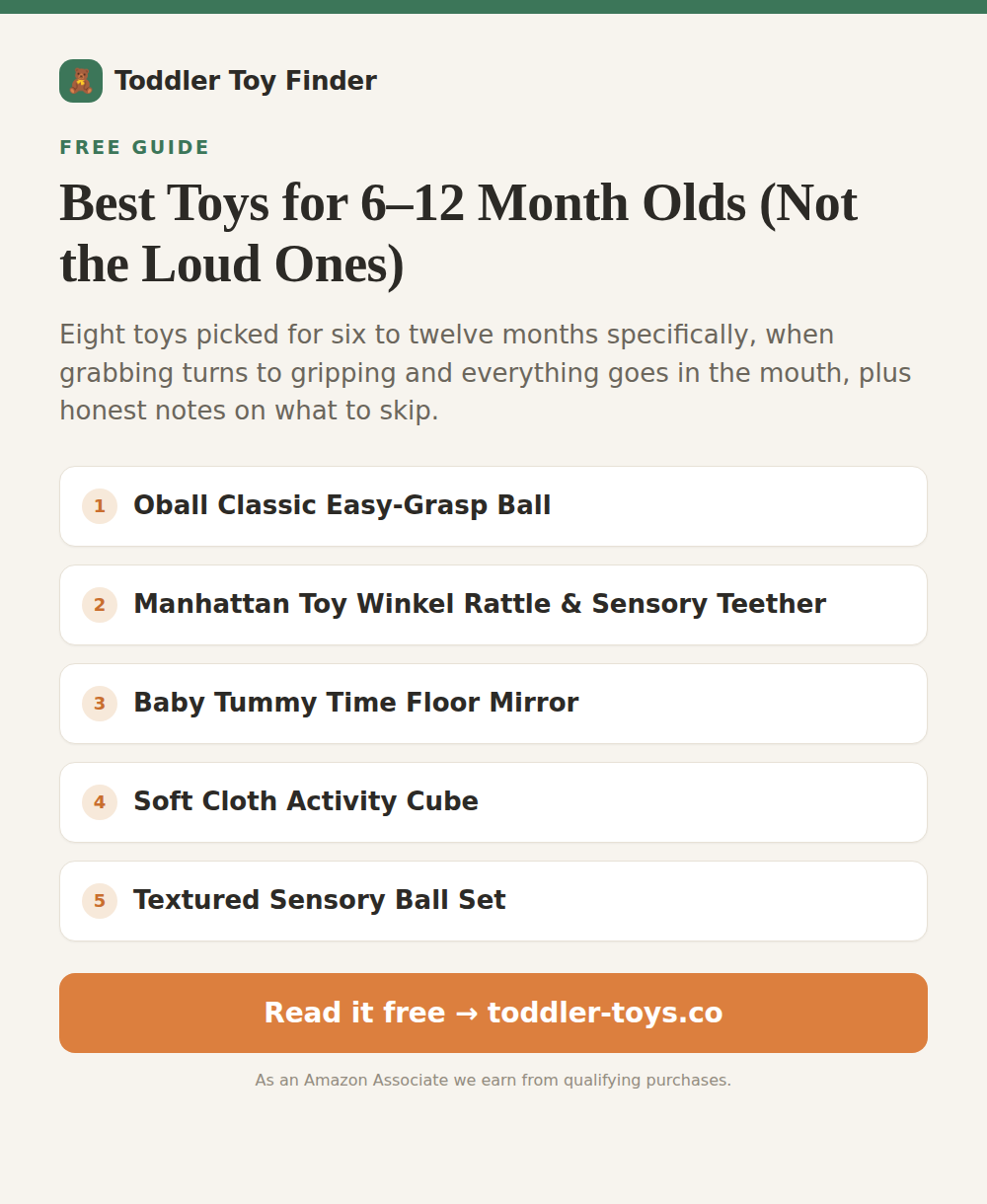
Six to twelve months is the stretch where a baby stops being a passenger and starts being a participant. They can reach for things and mostly get them, get things to their mouth on purpose, and by the end of it many are sitting unsupported, pulling to stand, or already cruising along furniture. None of that shows up in a toy catalogue, but it changes what's worth buying more than almost any other single factor.
The honest version of this list skips the toys that look impressive in a photo and buys for the toys that survive being grabbed, gummed, thrown, and occasionally sat on. Almost everything here is safe to leave a baby alone with for a few minutes, which at this age is worth more than almost any other feature.
Nothing on this list assumes your baby is ahead of or behind on any particular skill. Babies reach for things, sit up, and start moving on wildly different timelines within a normal range, and a toy that's ignored this month is often the toy they can't put down the next. Buy for where they are now, not where a chart says they should be.
The picks
Oball Classic Easy-Grasp Ball
The first toy that doesn't fight a six-month-old's hands. A regular ball skids away from an uncoordinated swipe; the open lattice means a stray hand usually connects with something anyway, and that first successful grab is what gets a baby reaching on purpose instead of by accident. It travels well and survives being posted through crib bars overnight.
Watch out: The loops trap crumbs, sand and hair, and it's fiddly to clean properly — it's dishwasher-safe on the top rack, which is the easy answer. Some versions have rattle beads sealed inside; check the seams on a well-chewed one.
Skip it if: If you already own a set of textured sensory balls, the overlap is real. Buy this one first though — it's the only ball a pre-one-year-old can reliably hold.
How long it lasts: Six months to about three years, and it costs little enough that losing it outdoors isn't a disaster.
Manhattan Toy Winkel Rattle & Sensory Teether
Before a baby can aim, this is the toy most likely to end up in a fist regardless of which way it's grabbed. Once teeth start coming in it doubles as the object that gets chewed hardest, which is oddly reassuring — you'd rather it take the punishment than the coffee table edge does.
Watch out: It's soft plastic, so it will end up permanently marked by teeth, and that's fine. The loops are flexible enough to be safe against a face but they do collect fluff. Not a toy that survives being left in a hot car.
Skip it if: Past about a year this stops being interesting — a walking child wants things that do something. It's a genuinely narrow-window purchase and worth being clear about that.
How long it lasts: Three to twelve months. Short, but it lands in a stretch with very few good options.
Baby Tummy Time Floor Mirror
Tummy time is the least popular activity in most six-month-old's day, and a face at floor level is the one reliable bribe. Prop it a foot in front of them and the same protest that lasts thirty seconds without it often stretches past five minutes with it in place.
Watch out: Buy one that's shatterproof — a real glass mirror at floor level with a baby on it is not the purchase to economise on. The propped card versions collapse easily; check it stands up under a nudge.
Skip it if: Once they're crawling this is done, and it's done abruptly. If your baby is already mobile, don't bother.
How long it lasts: About two to eight months, then it's finished completely.
Soft Cloth Activity Cube
One object that resets the boredom clock by turning a different side toward them. At this age a single texture holds attention for well under a minute, so the six separate distractions sewn into one cube matter more than any single one of them being especially good.
Watch out: It goes in a mouth constantly, so buy one that's machine washable and actually wash it. The mirror panel is usually the first thing to craze. Cheap versions have crinkle material sewn in loosely enough to work free.
Skip it if: If you've already got a play gym with dangling attachments, the sensory ground is well covered and this adds little.
How long it lasts: Four months to about two years, mostly as a car and pram toy at the back end.
Textured Sensory Ball Set
Cheap enough to buy without thinking twice, and the different surfaces mean a baby's grip adjusts constantly without anyone teaching them to. It's also the toy most likely to survive a year stuffed in the bottom of a nappy bag without falling apart.
Watch out: Most sets squeak or squirt water, which means water gets inside and stays there; if they're used in the bath, squeeze them dry or accept mould. Spiky ones are for squeezing, not for a face — supervise early on.
Skip it if: If you have an Oball and a couple of soft toys, this is a nice-to-have rather than a need. Buy it as the second ball purchase, not the first.
How long it lasts: Six months to three years, and they end up in the bath and the sandpit long after.
Crinkle Soft Cloth Book Set
A board book is still mostly a spectator activity at this age — the pages are too stiff for small hands to work alone. These fold flat, crunch on contact, and are the first books a baby can turn themselves, which is most of what makes shared reading stick before words arrive.
Watch out: They get chewed and need washing often, so check they're machine washable before buying. The crinkle material softens over time and eventually stops crinkling, at which point most of the appeal goes.
Skip it if: Not a substitute for board books — the content is minimal by design. Buy these as well as, not instead of.
How long it lasts: Three to eighteen months, and they're light enough to live permanently in a bag.
Soft Fabric Building Blocks
Six months is early for building anything on purpose, but stacking two blocks and immediately knocking them down again is well within reach, and the soft fabric means the knocking-down part causes zero damage to furniture, siblings, or the baby's own head.
Watch out: Soft means unstable — towers above four or five blocks lean and collapse, which frustrates some children. They also absorb everything, so buy washable. The printed images fade with washing.
Skip it if: If your child is already stacking confidently and you're choosing between these and wooden blocks, go straight to wood. These are the training version.
How long it lasts: Six months to two years, then wooden or plastic blocks take over.
Bath Stacking Cups
Bath time at this age is mostly about not crying in the water, and a pour-and-fill toy gives a distracted, splash-happy baby something to do with both hands that isn't grabbing at the washcloth. Buy the version with a drainage hole or you'll be squeezing mould out of it by month three.
Watch out: The classic problem is mould inside cups with a sealed hollow; buy ones with a drainage hole or squeeze them out every time. Wet plastic in a warm bathroom grows things quickly.
Skip it if: If you already own the standard stacking cups, just take those into the bath. There's no meaningful difference beyond the drainage hole.
How long it lasts: Six months to four years, and they cost little enough to replace when the mould finally wins.
Or use the finder to narrow these down by what you want it to help with →
What actually changes between six and twelve months
The single biggest shift is hand control. At six months, grabbing something is closer to a swipe than a plan; by twelve, most babies can pick up something the size of a raisin between finger and thumb and let go of it on purpose. Toys that ask for a full-hand grab work at the start of this window and get outgrown quickly; toys with small parts to poke, pull or press only start working once that pincer grip shows up.
The second shift is mouthing. Nearly everything goes to the mouth during this stretch, not out of hunger but because a baby's mouth gathers information faster than their hands can for months longer. That isn't a habit to interrupt — it's the reason every toy on this list is built to be chewed, washed, and chewed again without falling apart.
The third is mobility, and it's the one that ends this stage. Somewhere between eight and twelve months, most babies start pulling to stand or moving across a room under their own power, and the toys that mattered most in month six — the ones you dangle, prop, or hand to them — stop being enough on their own. A toy that only works lying down has a shelf life measured in weeks, not months.
What to skip in this window
Anything that needs to be operated for the baby rather than by them. A lot of the loudest toys on shelves at this age are built to be triggered by an adult holding them up, which turns play into a performance the baby watches rather than something they do.
Anything with small, separable parts. This sounds obvious, but it catches people out on hand-me-downs and older siblings' toys more than new purchases — something rated fine for a three-year-old is often a genuine hazard here, and it's worth checking every shared toy box rather than assuming it's safe.
Battery toys with one mode and one song. They're gripping for about a week, because the response is identical every single time and there's nothing left to discover once the novelty wears off. A toy that responds differently depending on how it's handled — squeezed, turned, dropped — holds interest for months instead of days.
How much you actually need to spend
Very little, and this is one of the few ages where that's straightforwardly true rather than aspirational. Most of the picks on this list cost less than a takeaway, and the two most-used items in most houses at this age — a set of stacking cups and a pile of board books — are neither expensive nor exciting to look at.
The case for spending more is narrow. A subscription box that hand-picks age-matched toys removes the guesswork, but you're paying for curation, not for anything the toys themselves can't do cheaper if you're willing to choose them yourself. The honest rule of thumb is that almost nothing at this age needs to cost more than about twenty dollars, and the toys that do cost more rarely earn it back in extra play.
Common questions
What's the first toy a baby actually needs?
Something they can grab from any angle without help, because grabbing on purpose is the skill everything else is waiting on. An easy-grasp ball or a soft rattle does this better than almost anything more elaborate, and both cost very little.
Is it normal for a baby to put every toy in their mouth?
Yes, and it continues well past this age for plenty of children. A baby's mouth gathers information — texture, shape, temperature — faster than their hands can for months longer, so mouthing is exploration rather than a habit to interrupt. Buy toys built to be chewed rather than trying to stop it.
My baby ignores expensive toys and only wants the wrapping paper. Is that a problem?
No, and it's close to universal. Paper crinkles, tears, and responds differently every time it's handled, which is exactly the kind of unpredictable feedback that holds attention at this age. Most toys can't compete with that novelty, and there's nothing to fix here.
When should I stop buying toys for lying down or sitting propped up?
Once a baby is reliably sitting unsupported or starting to pull to stand, which for most lands somewhere in the back half of this age band. There's no exact date — floor mirrors and propped activity toys just quietly stop getting picked up, and that's the signal, not a chart.
Are wooden toys worth the extra cost at this age?
Less than at older ages. A six-month-old can't yet appreciate the weight and finish that make wood satisfying for building, and everything at this stage gets mouthed and drooled on regardless of material. Fabric and soft plastic are easier to wash and gentler against an unsteady sitting baby's own head — wood earns its premium a bit later.
More guides
- Best Toys for 1-Year-Olds
- First Birthday Gift Ideas That Get Used
- Best Toys for 18-Month-Olds
- Fine Motor Toys for Toddlers
- Best Toys for 2-Year-Olds
- Genuinely Good Toddler Gifts Under $25
- Screen-Free Calm-Down Toys for Toddlers
- Toys That Help Toddlers Talk
- Best Toys for 3-Year-Olds
- Toys That Burn Toddler Energy Indoors
- Best Toys for 4-Year-Olds