Toys That Help Toddlers Talk
Updated 2026-08-11 · As an Amazon Associate we earn from qualifying purchases.
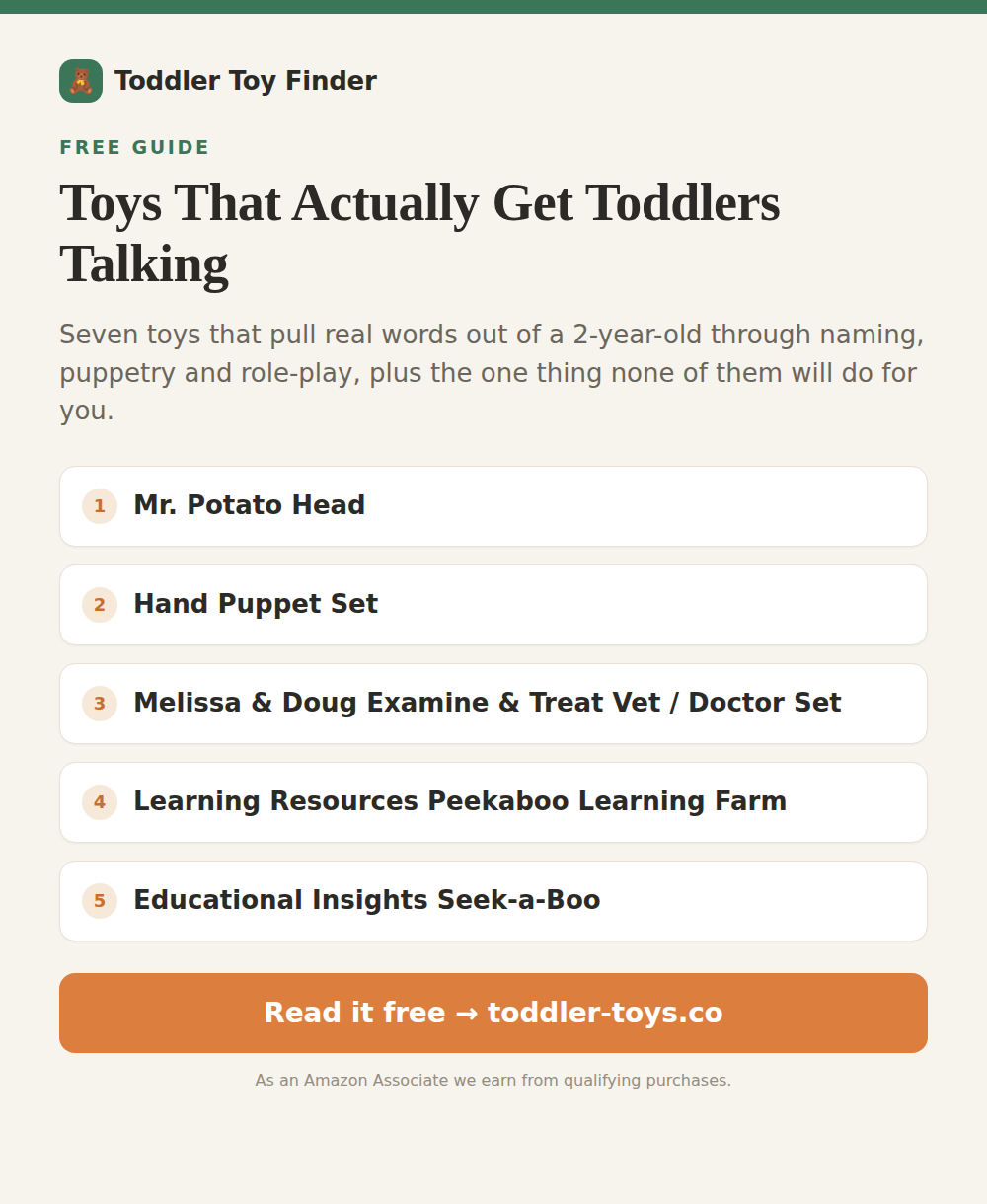
Most "language development" toys are just toys that talk. A button gets pressed, a recorded voice says a word, and somewhere a parent decides that counts. It doesn't do nothing, but it isn't the same thing as a toy that gets a two-year-old talking back — and that difference is what this list is actually sorted by.
The toys that reliably pull words out of a toddler this age share a mechanism, not a brand: they create a small gap the child wants to fill with language. A door that opens on a name, a puppet that seems to be listening, a doctor kit that needs a patient — each one sets up a moment where saying something gets a result, and a two-year-old who discovers that will chase it on purpose.
None of these substitute for a person talking with a child, and none of them should. What they're good for is giving a parent something to narrate alongside, and giving a child a reason to answer back instead of just watching. Seven picks, what each one is actually doing, and where it runs out of road.
The picks
Mr. Potato Head
Two is the sweet spot for this one — old enough to jam every piece into the wrong hole on purpose and narrate the mistake, which is funnier to them than getting it right. The names for ears, arms and shoes arrive as commentary, not as vocabulary drill.
Watch out: The pieces are small, plentiful, and scatter instantly; the storage compartment in the body helps only if you use it. Arms and the tongue-and-teeth pieces are the first casualties.
Skip it if: If your child is still mouthing everything, the small pieces make this a supervised-only toy, which limits how much it actually gets played with.
How long it lasts: Two to four years, and it's one of the cheapest things here.
Hand Puppet Set
Put one on your own hand before deciding this isn't your thing. A child who goes quiet when asked a direct question will often answer the puppet immediately — the switch from 'you' to 'a floppy dog' does more work than it should.
Watch out: You have to actually play with it — a puppet left in a toy box does nothing on its own, unlike most things here. Look for ones with a moving mouth rather than just a body; a puppet that cannot appear to speak loses most of the point. They collect dust and are usually surface-wash only.
Skip it if: Genuinely not for you if you would find performing with one excruciating. It is an adult-participation toy, and there is no shame in admitting that is not your thing.
How long it lasts: Two to about six, and the play deepens rather than fades — plots get more elaborate every year.
Melissa & Doug Examine & Treat Vet / Doctor Set
The stethoscope goes on everything in the house before it goes on a person, which is fine — words like open, listen, careful and all better arrive regardless of the patient. It plays best as a two-person game; alone it stalls fast.
Watch out: The stethoscope and blood-pressure cuff are the pieces that break, and the fabric bag wears at the seams. Nothing here does anything on its own, so it needs a play partner to get going, at least at first.
Skip it if: If your child plays mostly alone, this sits unused — it's a two-person toy in practice, whatever the box says.
How long it lasts: Two to four years, peaking around three when pretend play really takes hold.
Learning Resources Peekaboo Learning Farm
The barn doors are the whole mechanism: a half-second of not-knowing before the animal appears, and that small gap is what makes the name stick after the fortieth repeat. It's loud and battery-driven, so expect to hear it more than you'd like.
Watch out: It's electronic, so it has batteries, a volume that's louder than you want, and a chirpy voice you will hear in your sleep. The doors are the mechanical weak point and a forced one snaps.
Skip it if: If you'd rather your child's toys were quiet and wooden, skip it — this is unapologetically a battery toy and no amount of goodwill changes that.
How long it lasts: About a year, concentrated in the window where first words are arriving.
Educational Insights Seek-a-Boo
Slower than it looks, and better for it — finding a named photo means holding the word in mind while scanning, not just pointing at whatever is already visible. It needs an adult sitting down to run it; two toddlers left alone just scatter the deck.
Watch out: Cards bend, and a bent card is identifiable from the back, which quietly ruins the memory element. It plays best with an adult; two toddlers left alone with it mostly just scatter cards.
Skip it if: If you want something a child does independently, this isn't it. It's a together toy, and it needs about ten minutes of your attention to be worth anything.
How long it lasts: Eighteen months to four years, with the rules scaling as they grow.
LeapFrog 100 Words Book
The tap-and-hear format repeats the same word dozens of times without an adult saying it dozens of times, which nobody has the patience for. The bilingual toggle is a genuine extra if Spanish is spoken at home, not a feature tacked on to the box.
Watch out: The pages are the failure point; they tear at the spine with heavy use. Volume is loud, and the pronunciation on a few words is noticeably off. Batteries are fiddly to change.
Skip it if: It won't teach a language on its own, and it's worth being clear about that — as a supplement it's good, as a plan it isn't.
How long it lasts: Eighteen months to three years, with heavy daily use in the middle of that.
Fisher-Price Little People Playset
A figure with a painted face gets treated as if it wants things, and deciding what it wants is the first real step toward telling a story instead of just naming objects. Hunt for the non-electronic version if you can find one — the quiet kind talks more, not less.
Watch out: Figures scatter and a set missing its people is not much of a set. Many versions are electronic with sounds and songs, which is either a feature or a nuisance depending on your tolerance; the non-electronic ones exist and are quieter.
Skip it if: If you already have animal figures or dolls your child narrates with, the gain here is small — buy a different category instead.
How long it lasts: Eighteen months to five years, with the storytelling years at the back end being the best of it.
Or use the finder to narrow these down by what you want it to help with →
What actually gets a toddler talking
Naming is the floor, not the ceiling. Pointing at a cow and saying "cow" is useful in the first year, but by two most toddlers can already do a version of that, and a toy that only offers more nouns to repeat stops earning its shelf space fast. What moves the needle at this age is turn-taking — a toy that sets up a back-and-forth rather than a one-way broadcast, so the child has to produce something to keep the exchange going, not just receive it.
Imitation does most of the heavy lifting underneath that. A puppet that seems to be listening, or a figure with a face, invites a child to supply the other half of a conversation because something appears to be waiting for it. That's also why toys built around a familiar voice work at all — the pull isn't the content, it's that a child already primed to imitate that voice will attempt sounds from it that a generic toy voice never gets out of them.
The other reliable trigger is self-narration: a toy that gets played with in motion, where the child talks through what's happening because there's no one else in the room to do it for them. It's quieter and less obviously "educational" than a talking toy, but it's some of the most genuine language practice on this list, because nobody prompted it.
What doesn't work as well as it sounds
Anything that talks at a child rather than to one. A button that produces the same recorded phrase every time is a good cause-and-effect toy and a mediocre language toy, because the exchange only runs one direction and there's nothing for the child to answer. It's fine as one toy among many; it's a poor bet as the main strategy.
Screens are the extreme version of the same problem. Even the gentlest, most deliberately paced children's video is still one-way, and a toddler watching a screen is not producing language, however much vocabulary is scrolling past. If a screen-based character has genuine pull with your child, a toy built around that same character can borrow some of the motivation — but the toy still has to ask something of the child to be worth buying, not just replay the show in miniature.
Flashcard-style drilling belongs in this category too, even when it's disguised as play. Holding up an object and demanding the word for it is a test, and two-year-olds are unreliable performers on demand — the same child who won't name a ball for an adult will happily shout "ball!" mid-throw with nobody asking.
How to get more out of any toy on this list
Narrate what you see rather than what you want to hear. "You put the ear on the foot" gets more genuine engagement than "can you say ear?", because it isn't a test and doesn't require a correct answer to keep going. The words still land — they just land as description instead of demand.
Wait a beat longer than feels natural before jumping in. Toddlers are slow to retrieve a word under any pressure, including friendly pressure, and filling every silence yourself removes the exact moment where they'd have reached for it themselves.
Follow whatever they're already doing instead of redirecting to what the toy is "for." A doctor kit used entirely on a teddy bear's foot is still doing its job. The vocabulary shows up inside whatever plot the child invents, not inside the plot printed on the box.
Common questions
My 2-year-old isn't talking much yet — is that normal?
The range at two is genuinely wide, and a quiet two-year-old often catches up without anything unusual having been done differently. That said, trust your own read of your child over a list on the internet — if you're worried, your pediatrician is the right person to ask, and asking early costs nothing.
Do talking toys and apps replace reading aloud?
No, and it isn't close. Reading together is slower, gives a child time to point and comment, and lets you follow their interest instead of a fixed script — none of which a button-press toy can do. Toys like these are a reasonable supplement to reading, not a substitute for it.
We're a bilingual household — should these toys worry us?
Not particularly. Most toddlers in bilingual homes sort out both languages over time, sometimes mixing them for a while first, which is ordinary rather than a setback. An English-only toy just means the other language is doing its work elsewhere — from you, not from the toy shelf.
Is it a problem that my toddler talks to the puppet more than to us?
It's actually a good sign. Rehearsing language on a puppet, a figure, or even a toy car is real practice, and children who talk freely to objects are usually the same children who'll talk to a person once the audience feels lower-stakes. Join in rather than redirect it.
More guides
- Best Toys for 6 to 12 Month Olds
- Best Toys for 1-Year-Olds
- First Birthday Gift Ideas That Get Used
- Best Toys for 18-Month-Olds
- Fine Motor Toys for Toddlers
- Best Toys for 2-Year-Olds
- Genuinely Good Toddler Gifts Under $25
- Screen-Free Calm-Down Toys for Toddlers
- Best Toys for 3-Year-Olds
- Toys That Burn Toddler Energy Indoors
- Best Toys for 4-Year-Olds