Best Toys for 3-Year-Olds
Updated 2026-08-07 · As an Amazon Associate we earn from qualifying purchases.
Three is the year pretend play stops being parallel and starts being cooperative — two three-year-olds playing "shop" will actually negotiate who's the customer, which almost never happened at two. It's also the year physical confidence outruns physical judgement: climbing, balancing and pedalling all arrive in quick succession, usually faster than caution does.
That combination changes what's worth buying. The toys that mattered at two mostly rewarded simple cause and effect — press this, get that. The toys that earn their keep at three reward planning and persistence instead: building something specific rather than just stacking, following a pattern rather than just threading, staying with a story for twenty minutes instead of two. A toy that does all the thinking for the child starts to feel babyish fast at this age, and that's usually the real complaint hiding behind "they're bored of it."
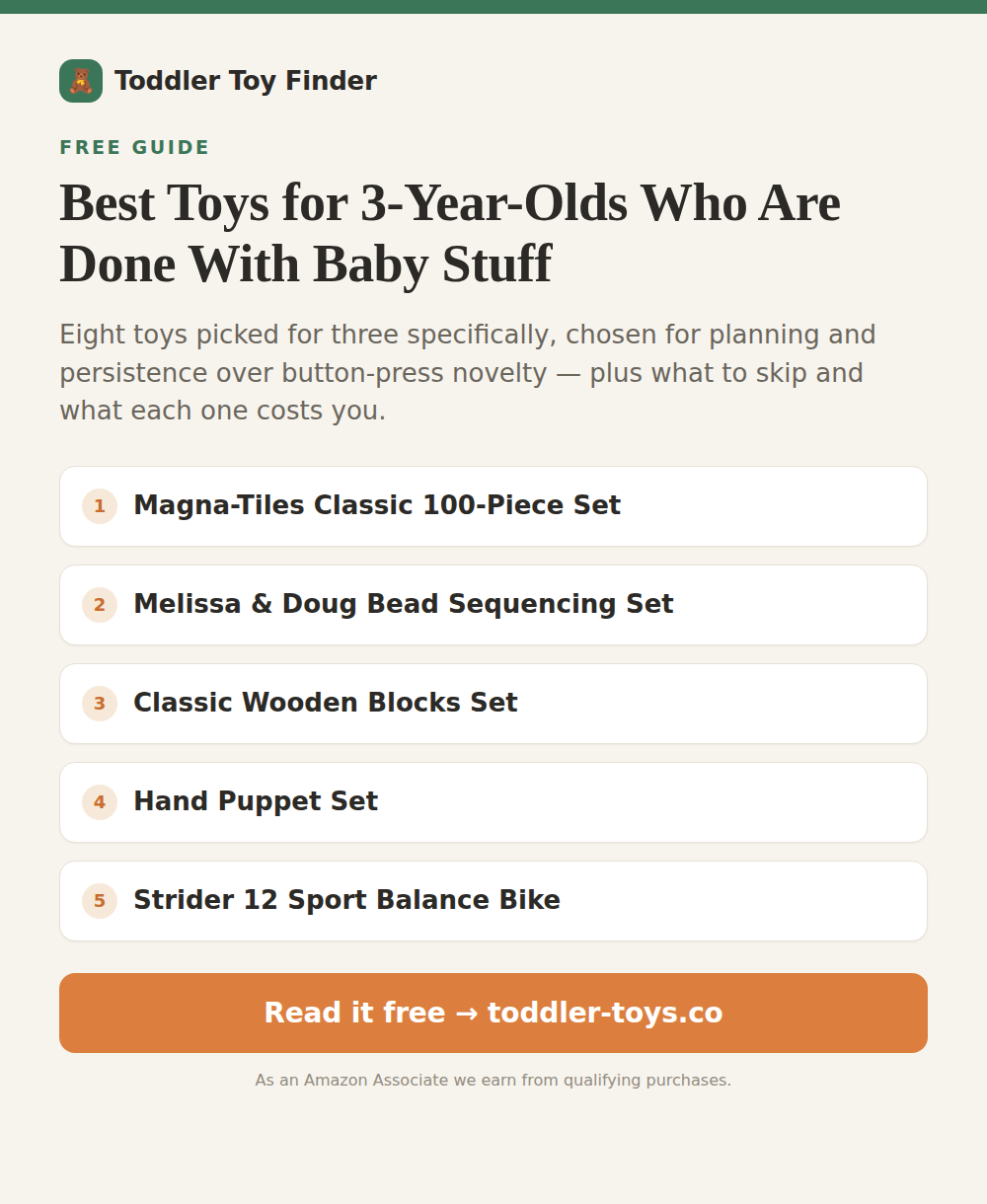
Eight picks below, chosen for this age specifically rather than borrowed from a general toddler list. Prices are shown as rough bands rather than dollar figures, since Amazon repricing would make any number here wrong within days.
The picks
Magna-Tiles Classic 100-Piece Set
Three is where this earns its price tag: building finally means planning a shape before touching a tile, rather than piling them up and knocking them over. The catch is real — a hundred pieces feels enormous until a second child gets involved, and then it thins out within a month. Buy it as the one big-ticket item on this list, not an impulse add.
Watch out: The magnets sit sealed inside a plastic shell. The risk isn't the magnet, it's a cracked tile, so retire any that split rather than taping them. Also: 100 pieces sounds enormous and stops being enough the moment a sibling joins in.
Skip it if: Under about two and a half there isn't much construction happening yet — they'll stack two tiles and wander off, and you've spent a lot for that. Cheap imitations vary wildly in magnet strength, and a weak set is genuinely worse than none, because nothing stays standing and the child concludes it doesn't work.
How long it lasts: Years. One of the few toys that gets more use at five than at three.
Melissa & Doug Bead Sequencing Set
The pattern cards are what make this a three-year-old toy rather than a leftover from two — copying a sequence instead of just threading beads randomly is a genuine step up, and you'll watch them start checking their own work against the card unprompted. It only works for a child willing to sit at a table for ten minutes, so don't buy it for one who plays standing up.
Watch out: Beads are large enough to be safe for the target age but small enough to vanish, and the pattern cards bend and get chewed. The wooden rods can crack if a child leans on a completed stack.
Skip it if: It needs a child who will sit down. If yours plays standing up and in motion, this will be abandoned in a week regardless of how good it is.
How long it lasts: Two to three years, because the pattern cards scale in difficulty as they grow.
Classic Wooden Blocks Set
What changes at three is that a tower stops being the whole game — it becomes a garage, a castle, a shop with a queue, and the building is now in service of a story rather than the point of it. The weight that makes towers satisfying also makes a falling block genuinely painful, so keep siblings and bare feet clear of a live build.
Watch out: Weight cuts both ways: a falling wooden block on a bare foot or a younger sibling's head genuinely hurts. Check for sanded edges and a non-toxic finish, and be aware that cheap sets warp if they get damp, after which nothing stacks straight.
Skip it if: If your child has never shown interest in stacking anything, start with something with built-in feedback — a shape sorter or Mega Bloks — and come to blocks once building is already fun.
How long it lasts: Two to seven years. Bought once, used for a childhood, then handed on.
Hand Puppet Set
Three is the age puppets start earning their keep, because a child who mumbles one-word answers to a direct question will hold a proper back-and-forth with a felt fox instead. It asks something of you too — a puppet left in a drawer does nothing on its own, and if performing with one feels excruciating, this isn't the toy that fixes that.
Watch out: You have to actually play with it — a puppet left in a toy box does nothing on its own, unlike most things here. Look for ones with a moving mouth rather than just a body; a puppet that cannot appear to speak loses most of the point. They collect dust and are usually surface-wash only.
Skip it if: Genuinely not for you if you would find performing with one excruciating. It is an adult-participation toy, and there is no shame in admitting that is not your thing.
How long it lasts: Two to about six, and the play deepens rather than fades — plots get more elaborate every year.
Strider 12 Sport Balance Bike
Buy this now if you haven't already, because three is roughly the last easy window before a pedal bike with stabilisers becomes the default and the balance-first route gets skipped entirely. There's a genuine stretch of fear before the glide clicks in, and pushing through that badly can put a nervous child off riding altogether — get the seat low enough that both feet plant flat.
Watch out: There's a fear stage before the glide clicks, and pushing through it badly can put a child off. Get the seat height right — feet flat on the ground — because too high is what causes the fear. A helmet is non-negotiable and an extra cost.
Skip it if: If you have no safe flat space — no path, park, or long hallway — it will sit in a hallway unused. That's the main reason these get resold.
How long it lasts: Eighteen months to five years, and resale value is unusually strong.
Kinetic Sand Starter Set
This is the pick for a three-year-old who needs an off-ramp from a wound-up afternoon — it rewards slow, repetitive handling in a way running-and-jumping toys can't touch. It does travel: expect to find a few grains in a sock a week after the tray was last opened, and it's a genuine chore to get out of carpet once it's ground in.
Watch out: It does escape the tray, and it clings to socks and travels through a house. Vacuum it rather than trying to wipe it. It's non-toxic but unpleasant to taste, and it grabs hair and carpet fibres permanently.
Skip it if: Skip if you'd only allow it under close supervision — like Play-Doh, a sensory material that rarely comes out isn't worth the shelf space.
How long it lasts: Three to eight years. It doesn't dry out, which is its main advantage over Play-Doh.
Step2 or KidKraft Play Kitchen
Three-year-old pretend play wants a place, not just an object, and a kitchen gives them one to go to and be someone in — taking orders, describing what's cooking, deciding who eats first. It is furniture in every sense, including the assembly, and it arrives with almost no accessories, so budget for play food as a second purchase, not an optional one.
Watch out: It is furniture, and you should treat the decision that way — it needs a permanent spot and it's a nuisance to move. Assembly is genuinely lengthy. It comes with almost no accessories, so budget for food and pans on top of the sticker price.
Skip it if: Skip in a small flat, or if your child's pretend play hasn't started yet — under about two and a half it's an expensive storage unit. Wait for the first signs of role-play, then buy.
How long it lasts: Two to six years, and secondhand ones sell quickly.
Foam Bowling Set
The unglamorous pick on this list, and the one that quietly earns its place on a wet afternoon when climbing and scootering are off the table. Re-standing the pins after every roll is as much of the game as knocking them down, which is doing more for patience than it looks like it should. It barely rolls on carpet, so treat it as a hard-floor toy only.
Watch out: Foam pins are light enough to fall from a draught, which frustrates a child who has just set them up carefully. On carpet the ball barely rolls — this is a hard-floor toy. The printed numbers rub off quickly on cheaper sets.
Skip it if: If you already have a skittles set or an indoor basketball hoop, the overlap is real and this adds little.
How long it lasts: Two to five years, though after four most children want a heavier ball and a proper alley.
Or use the finder to narrow these down by what you want it to help with →
What three-year-olds actually want from a toy
The single biggest shift is that pretend play gets a plot. At two, a block is briefly a phone and then it's a block again. At three, the phone call has a caller, a reason, and often a whole ongoing story that resumes the next day — which is why open-ended toys with no fixed shape suddenly outperform toys that do one specific thing.
The second shift is physical. Balance, climbing and pedalling all become genuinely available in this year, often before judgement about height and speed catches up. Toys that channel that — a balance bike, a climbing frame, a wobble board — do real work in a way they simply couldn't a year earlier, because the body wasn't ready for it yet.
The third is patience for a process rather than just an outcome. A three-year-old will follow a pattern card, re-stand fallen pins, or rebuild a collapsed tower without being told to — persistence that mostly wasn't there at two. Toys that reward that persistence, rather than resolving instantly with one button press, are where the real engagement is now.
The toys that quietly fail at three
Anything that still does the playing for the child. A toy that lights up and plays a fixed tune on a button press, which was genuinely engaging at eighteen months, reads as thin and repetitive now — three-year-olds notice when a toy responds identically every time and lose interest faster than the box implies.
Toys pitched at "toddlers" generally, with no real age distinction, are worth a second look before buying. A shape sorter or a stacking toy that was exactly right at eighteen months is usually mastered and set aside well before three, and buying more of the same thing a child has already outgrown wastes shelf space a proper three-year-old toy would use better.
Board games with real rules are still mostly too early, whatever the box age range claims. Waiting a turn, following a fixed sequence and accepting a loss without a meltdown are skills most children are still building at three, not skills a game reliably teaches just by being played.
Spending well at this age
Three is where the case for one genuinely expensive item gets stronger, not weaker. A play kitchen, a set of magnetic tiles or a climbing frame bought now can realistically still be in daily use at six or seven, which is a different calculation from a toy that's interesting for one season and then done.
That doesn't mean the cheap end stops mattering. Kinetic sand, a puppet set and a foam bowling set between them cost less than one big-ticket item and get reached for constantly — often more often than the toy that photographed better in the box.
The middle band is still the one to be wary of: anything in the twenty-five to fifty pound or dollar range that does exactly one thing and nothing else. At three specifically, that's often a single-purpose electronic toy that gets a week of real interest and then a shelf position it never leaves again.
Common questions
Is 3 too old for building blocks?
No — if anything three is where blocks get more interesting, not less, because building is now attached to a story rather than being the whole activity. A three-year-old building a garage for toy cars is doing something genuinely different from a two-year-old stacking for the sake of stacking, even with an identical box of blocks.
My 3-year-old won't share toys with other kids — is that normal?
Very. True back-and-forth sharing is still developing through this year, and a lot of what looks like sharing at three is actually parallel play with occasional swaps rather than genuine turn-taking. Toys with built-in roles, like puppets or a play kitchen, tend to ease this along faster than simply being told to share does.
What's a good outdoor toy for a 3-year-old who's nervous about new things?
Something that lets both feet stay on the ground while they get used to the idea — a balance bike beats a scooter or a bike with stabilisers for exactly that reason, because a nervous child can simply stop by putting their feet down rather than needing to be caught. Let the fear stage run its course rather than pushing through it too fast.
Do 3-year-olds still need loud, electronic 'learning' toys?
Less than the shelves suggest. By three, most children get more sustained value from open-ended toys — blocks, kitchens, sand, puppets — than from a toy that presses a button and states a fact, because the electronic version has usually shown them everything it does within the first few sessions. A quiet toy that can be reused a hundred different ways tends to outlast a loud one built to be used only the one way it was designed for.
More guides
- Best Toys for 6 to 12 Month Olds
- Best Toys for 1-Year-Olds
- First Birthday Gift Ideas That Get Used
- Best Toys for 18-Month-Olds
- Fine Motor Toys for Toddlers
- Best Toys for 2-Year-Olds
- Genuinely Good Toddler Gifts Under $25
- Screen-Free Calm-Down Toys for Toddlers
- Toys That Help Toddlers Talk
- Toys That Burn Toddler Energy Indoors
- Best Toys for 4-Year-Olds