Best Toys for 18-Month-Olds
Updated 2026-08-08 · As an Amazon Associate we earn from qualifying purchases.
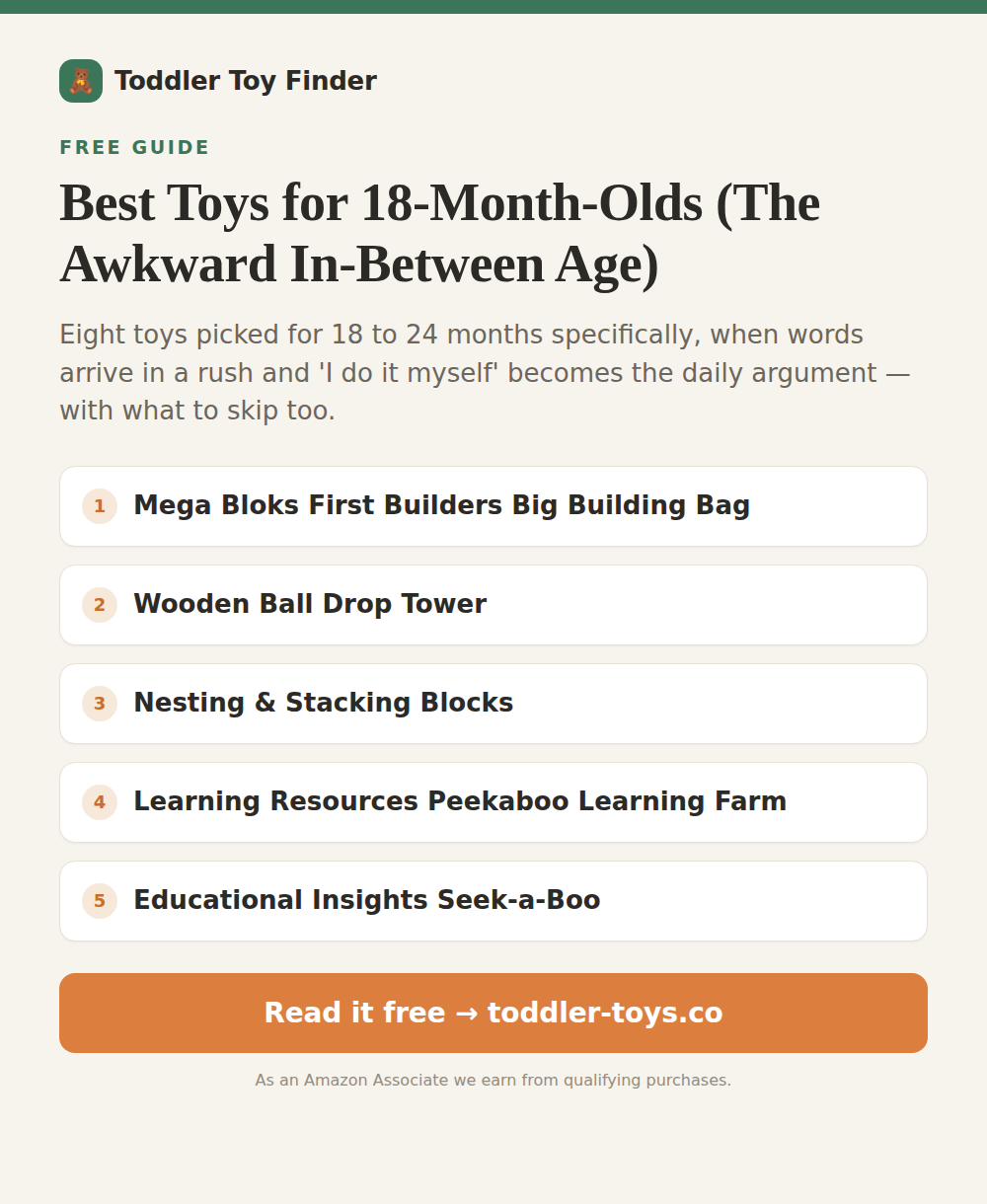
Eighteen months sits in an awkward gap between two better-known stages. It's past the wobbly-first-steps phase that dominates twelve-month lists, and it's not yet the storytelling, pretend-play stretch that takes over closer to two and a half. Most buying guides quietly skip over it, folding it into whichever neighbour is easier to write about. That's a mistake, because this window has its own very specific character, and a toy built for either neighbouring stage often lands wrong here.
The headline change is language, and it tends to happen fast enough to notice week to week. A child who knew a dozen words at the start of this stretch may have several dozen by the end of it, and two-word combinations start showing up unprompted. Right alongside that comes a stubborn streak of independence — a strong preference for doing things themselves, badly, over watching an adult do them well. Toys that let a child succeed alone, even at something small, tend to reduce the frustration that this combination produces; toys that require an adult to operate them get pushed away, sometimes literally.
Physically, this is also the stage where walking stops being the achievement and starts being the baseline — running, climbing onto furniture, and a rough overhand throw all show up somewhere in this window, usually before judgment about height and speed catches up with the new ability. Below, prices sit in bands rather than fixed dollar figures, since Amazon adjusts pricing often enough that a number printed today would already be stale.
The picks
Mega Bloks First Builders Big Building Bag
Sized exactly right for a child who wants to build something and get frustrated by nobody but themselves. The click-and-pull action needs real force, which is the point — a toy this age can operate start to finish alone is worth more than one that's cleverer but needs help.
Watch out: They're plastic and lightweight, so structures are wobbly and don't survive being carried. Mixing brands is a false economy — off-brand blocks often don't grip properly, and a tower that collapses on its own reads to a toddler as failure.
Skip it if: Past three, most children have outgrown the chunkiness and want DUPLO instead. Buying this at three and a half wastes a year.
How long it lasts: Twelve to eighteen months before DUPLO takes over.
Wooden Ball Drop Tower
The appeal here has nothing to do with novelty and everything to do with repetition — the same drop, the same clatter, over and over, at an age that genuinely wants exactly that. Watch for the shift from lobbing balls in randomly to lining one up deliberately before letting go.
Watch out: The balls are a choking size and they roll under furniture immediately; a set with fewer, larger balls is easier to live with. It's loud on a hard floor. Check the ramps are firmly fixed, since a loose one jams constantly and a jamming toy gets abandoned.
Skip it if: If you already have a ball run or a marble-run style toy, skip — the play pattern is identical and neither adds to the other.
How long it lasts: Ten months to two and a half years, ending abruptly once the surprise of where the ball goes wears off.
Nesting & Stacking Blocks
Working out that the blocks only nest in one order is a real, if invisible, cognitive task, and it takes most of this stage to click. Expect a fair amount of jamming things in wrong before the sequence sinks in — that struggling is the useful part, not a sign it's the wrong toy.
Watch out: Cardboard versions dent and split once they get damp or stood on, and a dented block won't nest. Sets vary in whether the printing is any good; some are cluttered to the point of being useless for naming.
Skip it if: Considerable overlap with stacking cups — own one or the other, not both. Cups win for the bath, blocks win for tower height.
How long it lasts: Eight months to three years, and the printed faces keep it useful as a naming toy after the stacking stops.
Learning Resources Peekaboo Learning Farm
Built for exactly the word rush that defines this age. Opening a door and getting the same word back dozens of times isn't repetition wearing thin — at eighteen months that repetition is doing most of the actual learning, quietly, in the background.
Watch out: It's electronic, so it has batteries, a volume that's louder than you want, and a chirpy voice you will hear in your sleep. The doors are the mechanical weak point and a forced one snaps.
Skip it if: If you'd rather your child's toys were quiet and wooden, skip it — this is unapologetically a battery toy and no amount of goodwill changes that.
How long it lasts: About a year, concentrated in the window where first words are arriving.
Educational Insights Seek-a-Boo
Works earlier than the box suggests, though it's very much a together-toy at this age rather than something to hand over and walk away from. Naming a card out loud before they find it does more for the word than staying silent and just watching them search.
Watch out: Cards bend, and a bent card is identifiable from the back, which quietly ruins the memory element. It plays best with an adult; two toddlers left alone with it mostly just scatter cards.
Skip it if: If you want something a child does independently, this isn't it. It's a together toy, and it needs about ten minutes of your attention to be worth anything.
How long it lasts: Eighteen months to four years, with the rules scaling as they grow.
Montessori Busy / Activity Board
This is the age of wanting to operate every real latch, plug and zip in the house, and this gives that urge somewhere to go that isn't a door handle or a seatbelt. Interest can burn out fast once every mechanism has been solved once — that's a normal outcome, not a faulty toy.
Watch out: Quality varies enormously. Cheap boards have components that break off within a week, and a broken fastening is a sharp edge or a small part. Check that everything is firmly mounted and that there are no loose screws before handing it over.
Skip it if: Interest can be short and sharp — some children exhaust every mechanism in an afternoon and never return. If yours moves on fast from single-purpose toys, this is a risk.
How long it lasts: Twelve to eighteen months, though it travels well in that window.
LeapFrog 100 Words Book
The tap-and-hear format matches this stage almost too well — a word said back instantly, as many times as they want it repeated, with no adult needed to keep the loop going. Good for the car seat and the waiting room specifically, where a physical book alone would get thrown.
Watch out: The pages are the failure point; they tear at the spine with heavy use. Volume is loud, and the pronunciation on a few words is noticeably off. Batteries are fiddly to change.
Skip it if: It won't teach a language on its own, and it's worth being clear about that — as a supplement it's good, as a plan it isn't.
How long it lasts: Eighteen months to three years, with heavy daily use in the middle of that.
Pop-Up Play Tunnel
A genuine physical challenge for a child who's just found running and climbing, dropping to hands and knees and pushing through a space they can't fully see out of. It also gives the new hiding instinct somewhere to go, which shows up around now whether or not there's a tunnel to enable it.
Watch out: The sprung frame snaps flat with real force when it collapses, so it is not something to leave a child to fold alone. The mesh panels tear if dragged across concrete. Cheaper versions have a strong plastic smell for the first week.
Skip it if: Not worth it if you have no floor space to leave it open — a tunnel that lives folded in a cupboard gets forgotten in a fortnight.
How long it lasts: Eighteen months to about five years, though the play changes from crawling through to hiding inside.
Or use the finder to narrow these down by what you want it to help with →
What's actually going on between 18 and 24 months
The clearest change is vocabulary, and it rarely arrives smoothly. A child can go from a handful of reliable words to naming everything in a room within a few months, often in a rush that outpaces their ability to be understood — which is part of why this stage has a reputation for frustration. Toys that reward naming something out loud, rather than just pointing at it, are doing real work here even when they look like nothing more than a noisy box.
Right behind language comes a strong pull toward doing things without help. This isn't defiance so much as a genuine drive to test what their own hands and body can manage alone, and it shows up as a flat refusal of assistance on tasks that clearly still need it. A toy a child can complete unaided — however slowly, however messily — tends to land better right now than a cleverer one that needs an adult's hands in the middle of it.
Physically, walking has stopped being the news. Running, climbing onto low furniture, and a rough throwing motion all tend to show up somewhere in this stretch, generally before the judgment to go with them. That gap between new ability and new judgment is worth planning around rather than being surprised by.
What quietly fails at this age
Toys pitched broadly at 'toddlers' with no real distinction between twelve months and two years are worth a second look before buying, because this stage genuinely differs from both. Something that was exactly right at a year — a soft rattle, a simple grasping toy — is usually mastered and abandoned by now, and something built for pretend storytelling at two and a half is often still a year premature.
Anything with a lot of small, loose, separable pieces is still a real risk here, not a theoretical one — plenty of children this age still mouth things reflexively, especially when tired or bored. A set with dozens of tiny accessories is better saved for later, whatever the recommended age on the box says.
Single-response electronic toys — the kind that light up and play one fixed tune on a button press — tend to hold interest for a couple of weeks on novelty alone and then stop. At this age a toy that always responds identically gets noticed as boring faster than the packaging implies, because the child pressing the button is actively looking for something to change.
What this age actually costs
Very little needs to be expensive here. Most of what gets reached for daily in this window — a stacking set, a tap-to-hear book, a simple busy board — sits in the cheapest price tier, and the appeal has more to do with matching the stage than with build quality or brand.
The stronger case for spending more is durability across a long stretch rather than sophistication in the moment. A wooden drop tower or a sturdy building-brick bag can plausibly still be in rotation well past this age band, which changes the value calculation compared to something interesting for a single season.
The band worth being wary of is the mid-priced single-purpose electronic toy — the kind that does one thing, does it loudly, and gets set aside once the novelty wears off within a couple of weeks. That's a common regretted purchase at this age specifically, more so than at either twelve months or two years.
Common questions
My 18-month-old barely talks — should I be worried?
There's a wide normal range at this age, and plenty of children with a small spoken vocabulary understand far more than they say. What tends to matter more than the word count itself is whether understanding is clearly growing — following simple instructions, pointing to named objects. If speech seems to be genuinely stalled rather than just behind a sibling's pace, it's worth mentioning at a routine check-up rather than guessing from a toy list.
Why does my toddler suddenly refuse help with everything?
It's a normal and fairly universal phase, driven by a real want to test what they can manage alone rather than defiance for its own sake. Toys that can be completed start to finish without adult hands in the middle — a stacking set, a simple drop toy — tend to go over better right now than ones that need help partway through, precisely because 'I did it' matters more than 'it worked perfectly.'
Is 18 months too early for shape sorters and puzzles?
Not too early to own one, but expect a real gap before matching actually clicks — most children this age treat a shape sorter as a box to fill and empty rather than a matching task at first, and that's normal use rather than a wasted purchase. The genuine matching skill tends to firm up closer to the back half of this stage.
How much active, physical time does an 18-month-old actually need?
More than most indoor spaces comfortably allow, which is why this is a good age to plan around gross-motor toys deliberately rather than as an afterthought. A tunnel, some floor space to run laps of, or somewhere to climb safely tends to head off a lot of the friction that comes from that energy having nowhere else to go.
Should I worry that my toddler only wants one toy right now?
Generally no — narrow, repetitive interest in one object is common at this age and is usually how a child masters something, rather than a sign of a limited attention span. Offering variety on top of an existing obsession rarely broadens it faster; letting the fixation run its course tends to work better, and it does move on by itself.
More guides
- Best Toys for 6 to 12 Month Olds
- Best Toys for 1-Year-Olds
- First Birthday Gift Ideas That Get Used
- Fine Motor Toys for Toddlers
- Best Toys for 2-Year-Olds
- Genuinely Good Toddler Gifts Under $25
- Screen-Free Calm-Down Toys for Toddlers
- Toys That Help Toddlers Talk
- Best Toys for 3-Year-Olds
- Toys That Burn Toddler Energy Indoors
- Best Toys for 4-Year-Olds